PanOptimization showcases PanX for large-scale metal AM modelling
PanOptimization, headquartered in State College, Pennsylvania, USA, has highlighted the use of its PanX simulation software in the Additive Manufacturing of large-scale, complex components. The platform is designed for AM machines with 1,000 mm-class build volumes and beyond, including multi-laser machines.

During a product development lifecycle, most metal AM teams rely on simulation software that accurately calculates distortion, residual stress, interlayer temperatures, and flags possible metal AM build failure modes, the company explains. However, the key challenge is whether these simulations can be applied to production parts on large-format systems, rather than remaining limited to smaller-scale research and prototyping.
The challenge is the combination of small features and large part envelopes. Companies can require building 0.2 mm-class features inside 1,000 mm-class build envelopes, often on large multi-laser systems. The cost of a failed build on today’s large-format multi-laser production systems forces a new requirement: modelling tools must resolve fine geometric details and account for the entire build volume, so engineers can improve outcomes through virtual iteration rather than slow and expensive experimental trial-and-error.
PanOptimization states that PanX was designed for the “too large, too complex” regime from the outset. The company claims that technologies such as Periodic Adaptivity and Multi-Grid Modeling enable meshing and simulation of finite element analysis (FEA) models that are 100 – 1000× larger than traditional approaches can handle, meaning hundreds of millions, and even billions, of elements become feasible while running on an engineering workstation.
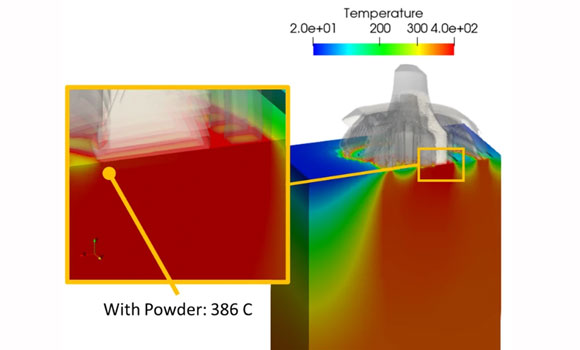
PanX reportedly offers high distortion and temperature prediction accuracy at mesh resolutions that fully capture thin features, while also handling the entire build volume and loose powder. Those high-accuracy predictions can also be used to optimise build outcomes. The company states that previously impossible parts can be simulated in hours and parts that could be simulated in other solvers can run 100× faster.
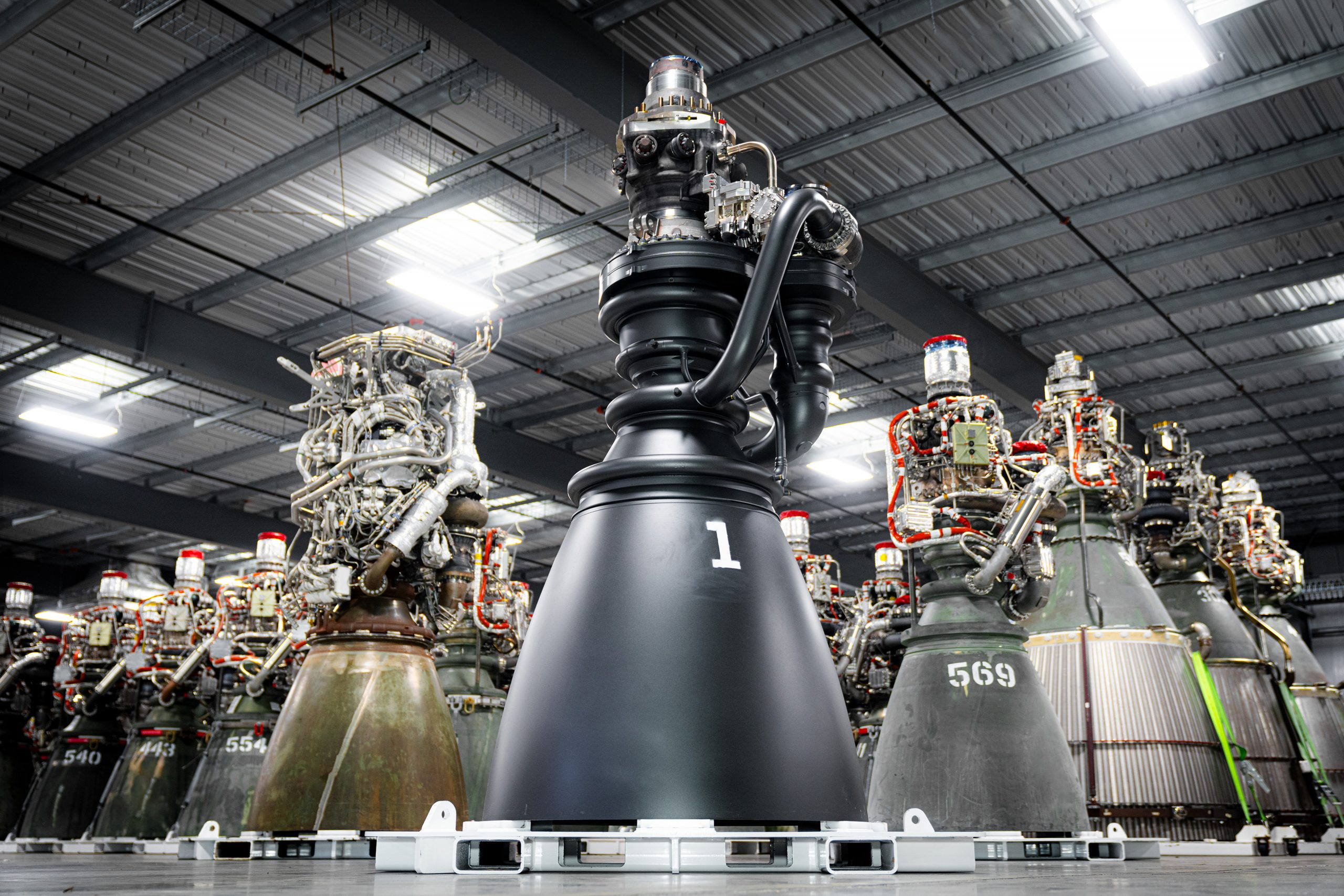
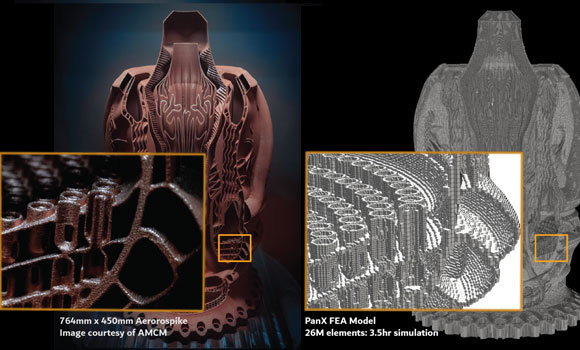
In the aerospike example shown here, the full part with powder was simulated in 3.5 hours, a case that the company states would not be possible to mesh, let alone solve, in another solver at comparable mesh resolution. The mesh contained 26 million elements and 57 million nodes. PanOptimization states that traditional FEA tools typically need to stay under approximately 5 million elements, which forces simplification that significantly compromises accuracy. The simulation was performed on an Intel Xeon 60-core CPU using 120 GB of RAM, a workstation-class desktop with practical specifications. Many PanX simulations can reportedly also run on an engineering laptop with 32 – 64 GB RAM.

Especially for large builds, simplified heat-loss boundary conditions are a detrimental assumption. PanX includes loose powder in the simulation and explicitly models the build plate, enabling realistic heat transfer and thermal history calculations. Traditional modelling approaches would not be able to mesh the loose powder volume at this scale because the computational cost would be prohibitive.
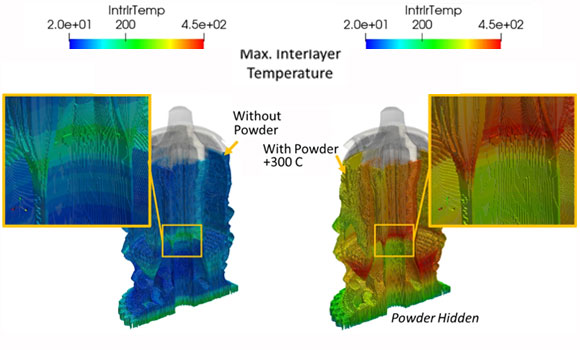
The company shared that ignoring powder often means that users are simulating a different process than the one actually being run. Modelling of loose powder is critical for accurate temperature and distortion calculations.
In addition to modelling loose powder, it is also critical to model the entire build plate and all the parts included on it. The build plate is not just a heat sink; it also impacts both distortion and residual stress.
Additionally, the company claims that PanX provides reliable, accurate insights in sufficient time before a build is started.