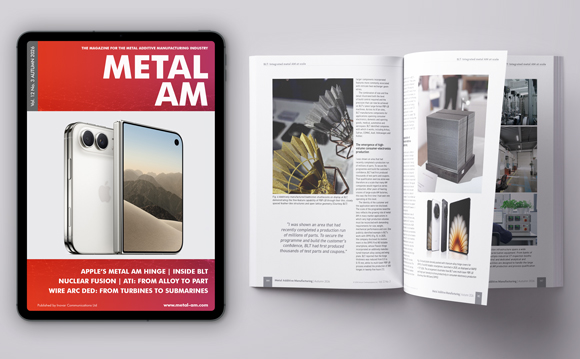
Metal Additive Manufacturing, Vol. 12 No. 3 Autumn 2026
Prefer a PDF download? Click here
In addition to the latest industry news, this 244-page issue of Metal Additive Manufacturing magazine includes the following exclusive features:
BLT: Inside the world’s largest metal Additive Manufacturing parts-production operation
Bright Laser Technologies (BLT) is one of China’s largest metal AM machine producers, but the scale of its parts-production business is less well known. With between 900 and 1,000 Laser Beam Powder Bed Fusion (PBF-LB) machines operating internally, its Xi’an facilities likely represent the world’s largest concentration of metal AM production capacity.
Martin McMahon visited the site for Metal AM magazine, meeting founder, Chairman and CEO Dr Xue Lei and Vice President Vincent Wanhu Yang, and reassessing assumptions about how far metal AM has progressed towards true mass production.
| Get PDF | | | Read online |
Nuclear fusion’s manufacturing challenge: Where metal Additive Manufacturing can make the difference
As nuclear fusion advances towards power plants, attention is shifting from plasma performance to manufacturing reliable reactor hardware.
Drawing on individual interviews with experts from Fusion for Energy, UK Atomic Energy Authority, Max Planck Institute for Plasma Physics, University of Birmingham, Novatron Fusion Group and Freemelt, Ulric Ljungblad examines where metal AM could earn its place – from tungsten plasma-facing components and tungsten-copper interfaces to integrated cooling and maintainability – and what is needed to achieve qualified industrial production.
| Get PDF | | | Read online |
From alloy design to aerospace components: Industrialising the ATI® 1700® superalloy for metal Additive Manufacturing
Developing a new nickel-based superalloy for Additive Manufacturing involves more than achieving improved mechanical properties. Alloy design, powder production, process development, heat treatment and qualification must all be addressed.
Matias Garcia-Avila and Austin Mann of ATI examine the development of the ATI 1700 superalloy, from alloy screening through to complex AM components and large-format manufacturing. Their account highlights the technical challenges, industrial capabilities and qualification requirements involved in bringing a new high-performance material into wider use in demanding aerospace and defence applications
| Get PDF | | | Read online |
From coupon to component: Qualifying wire arc DED for the US Submarine Force
As the US Navy looks to expand the use of wire arc Directed Energy Deposition (DED) across the Submarine Industrial Base, qualification must move beyond controlled test coupons to large, geometrically complex production parts.
AML3D’s work explores how thermal behaviour, bead geometry, process parameters and software control can be managed as build scale increases, while new US Navy qualification and material-interchangeability frameworks aim to remove barriers to adoption. The research examines thermal compensation strategies to support the transfer of qualified procedures to full-scale submarine components.
| Get PDF | | | Read online |
Scaling wire arc Directed Energy Deposition: Building on existing qualification evidence at WAAMathon #3
Scaling wire arc Directed Energy Deposition requires manufacturers to understand how changes in equipment, materials and component design affect a qualified process. Drawing on Siemens Energy’s series-production experience and discussions at WAAMathon #3 in Berlin, Christiane Herzer examines the practical foundations for wider adoption: standards that reflect industrial needs, access to qualification-relevant machine data and monitoring that strengthens the evidence base. Together, these approaches offer a route to faster industrialisation while preserving the rigour required for demanding applications.
| Get PDF | | | Read online |
Hidden cracks in pure tungsten: How JEOL changed the PBF-EB thermal cycle
Pure tungsten remains difficult to process by Additive Manufacturing, but its properties make it attractive for demanding high-temperature applications. JEOL’s high-temperature PBF-EB trials showed that a sound surface could conceal internal cracking. Looking beneath the surface through sectioning and microscopy led to a local pre-hatch strategy that improved internal quality.
Ulf Lindhe examines the resulting material properties, complex tungsten demonstrators, fusion-related trials, and the work still needed to scale and qualify the process.
| Get PDF | | | Read online |
Titanium bellows: Engineering flexibility and testing durability with metal Additive Manufacturing
Metal bellows must flex repeatedly without losing pressure integrity. Additive Manufacturing offers new freedom to tailor their geometry, but predicting the performance of thin-walled components remains a challenge.
Günter Kappler, Dominik Kunz and Michael Jan Galba investigate four Ti-6Al-4V designs produced by Laser Beam Powder Bed Fusion (PBF-LB), revealing an approximately ninefold range in axial stiffness. Their findings show where simulation falls short and why pressure testing alone may not reveal progressive fatigue damage.
| Get PDF | | | Read online |
Build plate resurfacing in metal Additive Manufacturing: A practical guide to process control
Build plate resurfacing affects far more than surface finish. As metal AM production scales up, control of this operation can help preserve plate life, improve plate turnaround and support consistent builds. From abrasive selection and workholding to inspection, traceability and automation, a repeatable process depends on more than the grinder alone.
Jennifer Rutz, President of DCM Tech, examines the practical requirements for returning plates to service and the factors manufacturers should weigh when considering whether to bring resurfacing in-house.
| Get PDF | | | Read online |
< Back to archive