LEAP 71 and HBD produce largest aerospike rocket engine to date

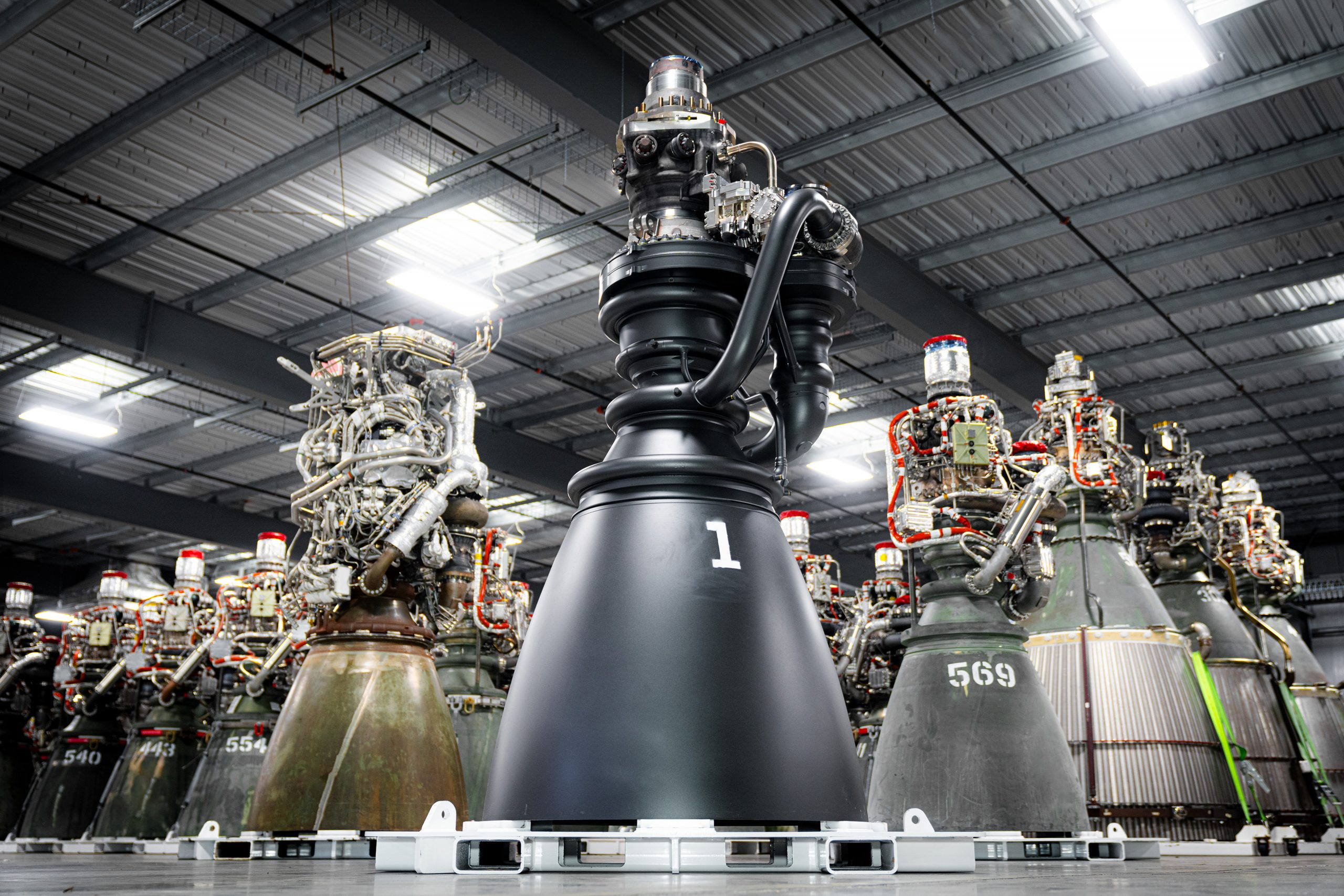
LEAP 71, headquartered in Dubai, United Arab Emirates (UAE), and Shanghai Hanbang 3D Tech Co, Ltd (HBD), headquartered in Shanghai, China, have produced an additively manufactured aerospike rocket engine capable of generating 20 tons of thrust (200 kN / 45,000 lbf). The one-metre-tall cryogenic methane/liquid oxygen engine will be exhibited at the TCT Asia trade show, taking place in Shanghai from March 17-19, 2026.
The engine, designated XRA-2E5, was engineered using Noyron, LEAP 71’s Large Computational Engineering Model. Noyron uses first-principles physics, engineering logic and manufacturing constraints to autonomously generate functional designs without human intervention, states the company.
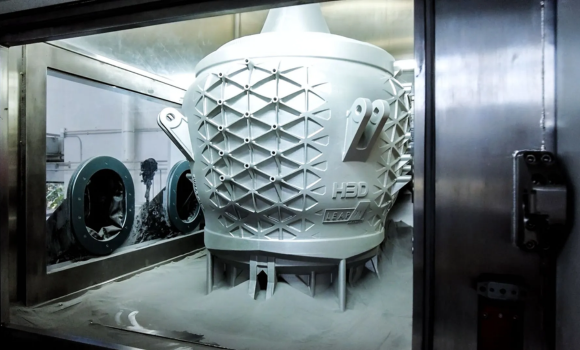
HBD additively manufactured the monolithic engine in 289 hours of continuous build time using the HBD 800 machine, a ten-laser metal Additive Manufacturing system with a build volume of 830 × 830 × 1250 mm.
“Aerospikes are often considered the holy grail of space propulsion,” said Josefine Lissner, CEO of LEAP 71 and principal architect of Noyron. “They promise major performance advantages over conventional engines, but their complex geometry has historically made them extremely difficult to design, manufacture and operate. We believe that by combining computational engineering with advanced Additive Manufacturing, we can finally make them fly.”
The engine shares its DNA with two earlier Noyron-generated aerospike engines that LEAP 71 hot-fired over the past 15 months. The 200 kN design, reportedly the largest additively manufactured aerospike ever produced, is suitable for the upper stages of large reusable launch vehicles.
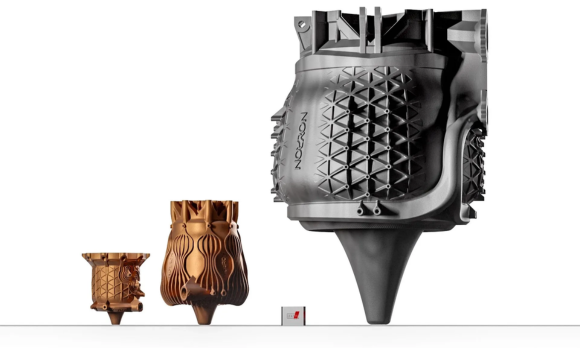
Aerospike engines use an “inside-out” architecture with a toroidal combustion chamber and a central spike. To manage the intense heat loads from the combustion gases, the XRA-2E5 uses a regenerative cooling strategy where the outer chamber is cooled by the cryogenic methane fuel, while the spike is cooled using liquid oxygen.
Unlike conventional engines with their bell-shaped nozzles, aerospikes maintain high efficiency from sea level to vacuum, making them particularly attractive for next-generation launch systems that reuse both stages of the rocket. In a fully reusable launch system, both the booster and the upper stage return to the launch site, requiring propulsion systems that operate efficiently inside and outside the Earth’s atmosphere and provide deep throttling capability.
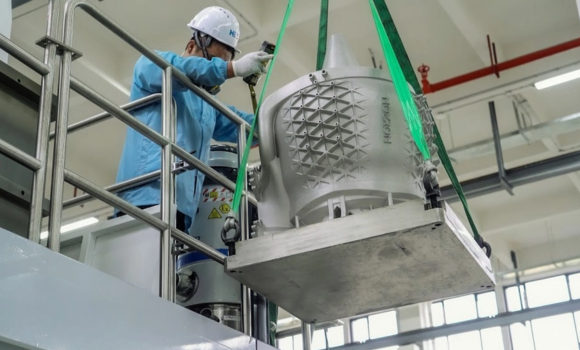
Kevin Chen, Director of Marketing at HBD, shared, “Just a year ago, producing an engine like this at this scale would have been impossible. The physics-driven geometry of the aerospike, with shallow overhangs and intricate internal structures, pushes even advanced metal printing processes to their limits. Successfully producing the engine on the first build demonstrates the stability and precision of HBD’s large-format Additive Manufacturing platform and provides hardware ready to move toward hot-fire qualification.”
The companies collaborated closely to align Noyron’s design strategy with the capabilities of HBD’s AM platform. The result is a fully integrated monolithic engine manufactured in Inconel 718, a high-temperature nickel superalloy commonly used in rocket propulsion systems.
The XRA-2E5 acts as a manufacturing validation milestone for LEAP 71’s multi-year propulsion development effort with Aspire Space for the fully reusable Oryx spacecraft.
HBD will exhibit the aerospike at TCT Asia in Shanghai, Hall 7.1, Booth 7E35.