LAYRR develops nano-coating process for metal AM powders

LAYRR, based in Abingdon, UK, has developed a high-speed surface engineering process, adapted from Physical Vapour Deposition (PVD), to modify standard metal powders at the atomic level. The approach is intended to transform widely available commodity powders into higher-performance materials for metal Additive Manufacturing applications.
“For years, the metal Additive Manufacturing industry has operated under a fundamental constraint: we have mastered the printer, but our progress is bottlenecked by the powder,” stated Phil Hunter, CEO of LAYRR. “We design limitless, complex geometries, but rely on bulk alloy formulations that are expensive and difficult to process, often relying heavily on critical metals”.
“At LAYRR, we are continually questioning the norm. We have developed a clean, high-speed atomic-level surface engineering process using technologies adapted from PVD that transforms standard commodity metal powders into high-performance, next-generation AM materials.”
While complex geometries can now be produced routinely, many applications still rely on expensive, difficult-to-process alloys, often containing critical raw materials.
High-value sectors, including aerospace, automotive and energy, can face supply chain constraints and long material qualification cycles. Demand for advanced superalloys and customised metal matrix composites (MMCs) is increasing, but conventional powder atomisation routes can be time-intensive and costly.
Developing new alloys for processes such as Laser Beam Powder Bed Fusion (PBF-LB) or Directed Energy Deposition (DED) may take several years, explained Hunter, while reliance on critical or geographically constrained raw materials introduces cost volatility and supply risk.
Nano-coatings and core-shell architectures
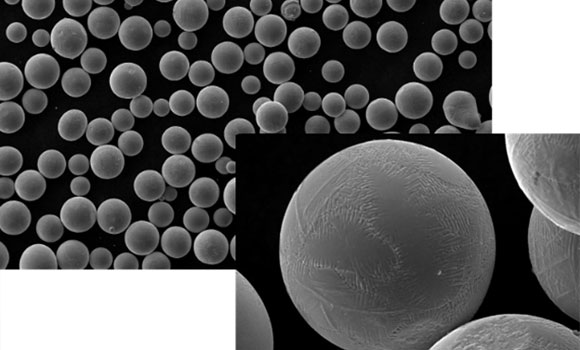
“Instead of relying on bulk alloying, LAYRR focuses entirely on the surface. We use a proprietary, fast, and precise process to deposit ultra-thin nano-coatings onto standard, readily available commodity powders. This creates a highly functionalised ‘core-shell’ powder architecture,” said Hunter.
By engineering materials at the atomic level, LAYRR can dictate the powder’s thermodynamic and kinetic behaviour during the AM process. This can lead to:
- Enhanced flowability and spreadability: The nano-coating alters the surface energy and inter-particle friction of the base powder. This improves bed density and recoater behaviour, even with highly cohesive or inherently fine commodity powders.
- Reflectivity and absorptivity control: For highly reflective metals like copper or aluminium, the surface engineering tailors the optical absorptivity at specific laser wavelengths. This expands the processing window and reduces the energy density required, while also minimising the risk of back-reflection damage to AM machine optics.
- In-situ microstructure control: During the harsh dynamics of the melt pool, the nano-coated shell acts as a localised grain refiner or alloying agent. Because the coating is uniformly distributed at the atomic level across every single powder particle, the resulting microstructure is much more homogeneous, mitigating issues such as hot tearing and porosity.
Rapid iteration
LAYRR’s process enables rapid iteration of material formulations, and is said to shorten material development cycles from years to weeks. By applying a surface treatment to existing commodity powders, rather than atomising new ingots from scratch, the company can quickly evaluate the effect of changing the nano-coating composition or thickness. This rapid, iterative approach, requiring no solvents or complex chemistries, enables the creation of new material systems that were previously considered impossible to manufacture.
Future development
With backing from investors in both the US and the UK, LAYRR is focused on scaling its technology and developing commercial applications across the aerospace, automotive, and energy industries. In aerospace, this includes improving oxidation resistance of established alloys such as Ti-6Al-4V and nickel-based superalloys through the application of refractory nano-coatings. In automotive, the focus is on enhancing the performance of aluminium powders for lightweight structures and thermal management applications. In the energy sector, the company aims to develop alternative material systems to reduce reliance on rare-earth or critical elements in power generation technologies.
“We believe the next evolutionary leap in Additive Manufacturing will be driven by materials science over faster lasers or larger build volumes. By shifting the focus from the bulk alloy to the atomic surface, we are unlocking the full potential of metal AM, delivering higher performance, resilient supply chains, and unprecedented speed to market,” concluded Hunter.