GKN Powder Metallurgy’s Dr Markus Schneider awarded Skaupy Prize
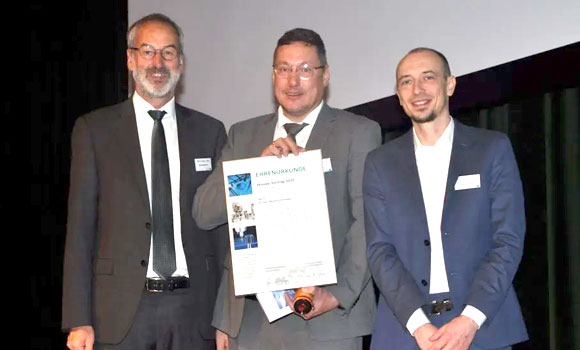
During the 43rd Hagen Symposium, organised by the Fachverband Pulvermetallurgie, Dr-Ing Markus Schneider of GKN Powder Metallurgy, Radevormwald, Germany, was presented with the 2025 Skaupy Prize.
Since beginning research on sintered components in 2006, Dr Schneider has worked to build expertise in the heat treatment of sintered steels to support GKN Powder Metallurgy. With around 100 publications to his name, he has focused on advancing fatigue strength and lifetime prediction for sintered and additively manufactured materials, driving developments in thermal management solutions and friction materials for rail applications, and studying damage tolerance, cyclic crack growth, and hydrogen-related fracture mechanisms.
The Skaupy Prize is the highest honour the Fachverband Pulvermetallurgie confers to distinguished powder metallurgists. Recipients of the prestigious award also present the opening lecture at the Symposium. This year, Dr Schneider presented ‘Time-dependent fracture phenomena due to stress corrosion cracking in high-strength porous sintered steels—causes, assessment and prevention.’
The lecture emphasised the importance of acquiring a fundamental understanding of stress corrosion cracking and its underlying causes. It was stated that potential avoidance strategies must address at least one of the three factors (static pre-stress, medium, and material). The paper investigated the effectiveness of potential subsequent processes considered effective, such as painting, steam bluing, oil infiltration, shot peening, zinc thermodiffusion treatment and passivation.
The influences of density and microstructure were also taken into consideration. In addition, the results were correlated and discussed with fractographic and metrological findings regarding fracture progression and hydrogen concentration.
Dr Schneider has played a leading role in the development of the FKM-Guideline (2024) for sintered steels.