Fraunhofer ILT to showcase powder flow control, porous structures and integrated sensors at Formnext
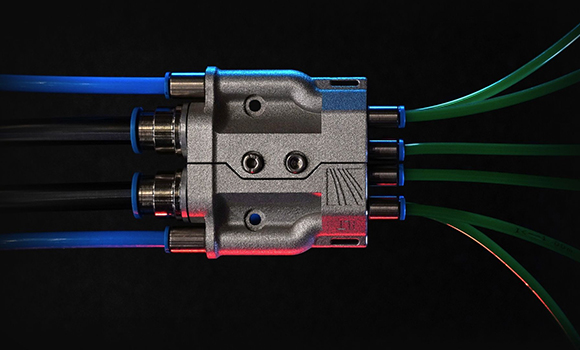
Fraunhofer Institute for Laser Technology ILT, Aachen, Germany, has announced plans to present three developments at Formnext 2026 in Frankfurt am Main, November 17–20. These include a powder flow control system for laser material deposition, graded porous structures for hydrogen applications and additively manufactured components with integrated sensors. The technologies will be exhibited at the joint Fraunhofer stand D31, Hall 11.0.
The institute aims to demonstrate how integrating additional functions into AM processes and components could reduce material consumption, manufacturing steps and system complexity.
“We look at Additive Manufacturing not only in terms of the component, but also of the entire process chain. Wherever our processes can eliminate an additional component, manufacturing step or maintenance task, that is where we focus our efforts,” stated Dr Tim Lantzsch, head of the Department of Laser Powder Bed Fusion at Fraunhofer ILT.
Fluidic Powder Switch reduces material losses
Fraunhofer ILT has developed a Fluidic Powder Switch designed to control metal powder flow during Laser Material Deposition (LMD) Additive Manufacturing. In conventional LMD processes, powder can continue flowing when the laser is temporarily inactive, resulting in material losses, contamination and potential safety risks.
Existing mechanical switching systems can take more than a second to interrupt powder flow and are subject to wear. Fraunhofer ILT’s alternative uses the Venturi principle to redirect powder away from the process zone and into a collection container. A control-gas flow generates negative pressure at a constriction, allowing powder flow to be interrupted directly at the nozzle within milliseconds.
The patented system has no mechanically moving parts in the powder path, reducing wear and maintenance requirements. In addition to switching powder flow on and off, it can switch between different materials and adjust the powder mass flow in stages.
According to Fraunhofer ILT, the system reduces switching times by more than an order of magnitude compared with mechanical alternatives. The institute also reports that the operating cost of the control gas is more than three orders of magnitude lower than the cost of the powder saved.
Viktor Glushych, group leader of LMD Coating and Heat Treatment at Fraunhofer ILT, who was involved in developing the technology, stated, “We are particularly pleased that the switch not only works in the lab, but is already being used in series production by our first customers. That was exactly what we set out to achieve: a robust, cost-effective solution suitable for industrial use.”
Graded porous structures for hydrogen applications
Fraunhofer ILT is also developing a method for producing components with controlled porosity using Laser Beam Powder Bed Fusion of metals (PBF-LB) Additive Manufacturing. The approach enables dense and permeable regions to be manufactured within a single monolithic component, with either sharp or gradual transitions between them.
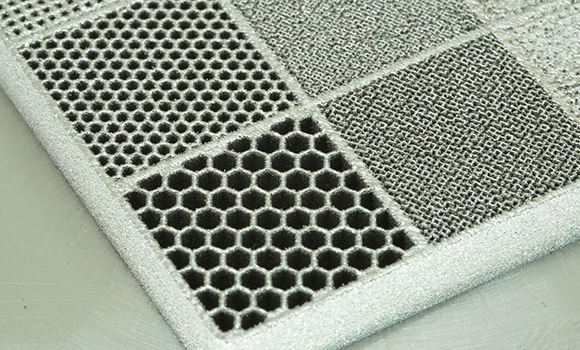
Conventionally, permeable structures such as metal foams, meshes and sintered filters are manufactured separately and subsequently joined to the component. Integrating these structures through AM could eliminate assembly steps and reduce the thermal and electrical resistance associated with joints.
As part of the LPBFCells project, funded by the German Federal Ministry for Economic Affairs and Energy (BMWE), Fraunhofer ILT is applying this approach to the production of porous transport layers (PTLs) for electrolyser cells.
Rather than assembling multiple sintered layers, the researchers produce an integrated structure incorporating the PTL, flow field and support features. According to the institute, this approach reduces contact resistance and allows new cell geometries to be developed and evaluated more quickly.
Fraunhofer ILT will exhibit an electrolyser cell demonstrator featuring a graded porous transport layer manufactured from pure titanium.
“By treating porosity as a design feature, we can tailor dense and permeable structures specifically to the component’s function,” explained Alexander Neuke, research associate at Fraunhofer ILT.
Neuke identified electrolysers and fuel cells as potential applications, particularly where different levels of porosity are required across a component’s thickness. The approach could also be relevant to filtration and turbomachinery applications.
Integrating sensors into AM components
The third development focuses on integrating sensors directly into metal AM components to enable the monitoring of mechanical loads and deformation.
Dr Samuel Fink, group manager of Thin Film Processing at Fraunhofer ILT, is investigating the integration of printed strain gauges into components manufactured using PBF-LB Additive Manufacturing.
Sensor layers can be deposited using inkjet, aerosol jet or pad printing, either during or after the AM build process. This allows sensors to be positioned within a component, including in areas that would otherwise become inaccessible after manufacture.
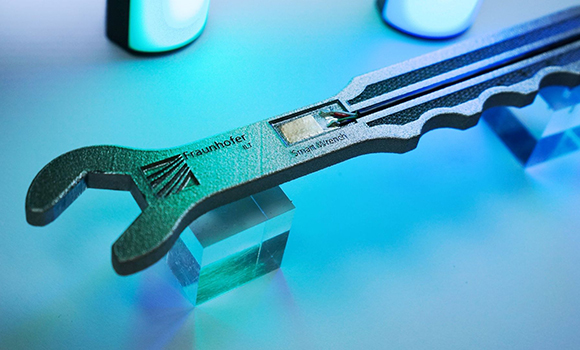
The institute will demonstrate a functional wrench prototype incorporating an in-situ printed strain gauge. The integrated sensor provides real-time measurements of deformation under load, which can be used to assess stresses within the component.
Embedding sensors in this way can also help protect them from mechanical abrasion and thermal loads. Fraunhofer ILT sees potential applications in condition monitoring, predictive maintenance and safety-critical components, while reducing the need for external measurement arrangements.
“The sensors provide data exactly where it matters most, inside the component,” stated Fink.
He also acknowledged that further development of suitable materials and robust, efficient manufacturing processes is needed before integrated sensor technologies can be more widely adopted in series production.