Eplus3D adds Oqton’s 3DXpert software for metal AM machines
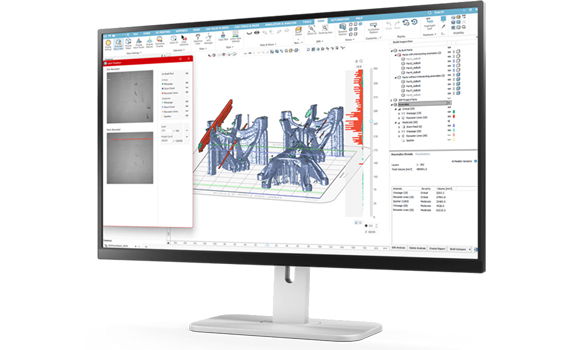
Eplus3D, Hangzhou, China, is collaborating with manufacturing software developer Oqton, Novi, Michigan, USA, to improve compatibility between Oqton’s 3DXpert software and Eplus3D Laser Beam Powder Bed Fusion (PBF-LB) Additive Manufacturing machines.
The collaboration combines Eplus3D’s equipment and application expertise with Oqton’s build preparation and process optimisation capabilities, with the aim of supporting more open, integrated and reliable software and hardware workflows.
The work focuses on two areas: applying 3DXpert’s MeltControl technology to challenging geometries and improving the transfer of build preparation data and process parameters to Eplus3D machines. The companies have completed a joint demonstration using MeltControl on an Eplus3D PBF-LB machine, while further software integration remains under development.
MeltControl for challenging geometries
In PBF-LB, low-angle overhangs often require support structures to stabilise the build and manage heat. These supports can increase material consumption and post-processing requirements, particularly in enclosed or difficult-to-access features.
MeltControl, available within 3DXpert, uses physics-based, localised scan path optimisation to address these challenges. Rather than applying uniform process parameters throughout a part, it uses simulation-driven scan vector adaptation to adjust energy input according to local conditions.
The technology considers factors including down-facing angles, proximity to heat-sinking material and local thermal conditions. This approach may reduce the need for conventional supports and enable the manufacture of geometries that would otherwise require extensive support removal. The extent of any improvement depends on the application and process.
Inconel 718 demonstration on the EP-M300
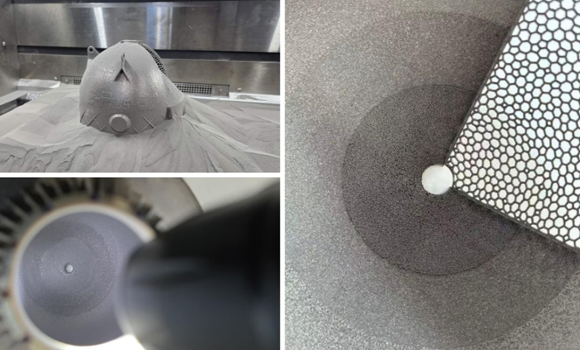
Eplus3D and Oqton have demonstrated the technology by manufacturing a complex Inconel 718 fuel tank on the Eplus3D EP-M300 using 3DXpert and MeltControl. The component’s curved profile and low-angle overhangs provided a test case for localised scan strategy optimisation.
Eplus3D supplied the EP-M300 machine and technical support, while Oqton provided software and process optimisation expertise. The completed build demonstrates the application of MeltControl-based scan strategies on Eplus3D equipment and provides a reference for further development.
Similar approaches may be applicable to other complex geometries in aerospace and propulsion applications, including volutes, turbopump components and complex flow passages.
“At Eplus3D, we see software compatibility as an essential part of delivering practical industrial metal additive manufacturing solutions,” stated Raymond Zhang, Sales Director APAC, International Business Department at Eplus3D. “The Inconel 718 fuel tank printed on our EP-M300 shows how Oqton’s MeltControl can be applied in a real build. As part of this partnership, 3DXpert is now offered as one of the standard software options for Eplus3D systems. Through deeper 3DXpert integration, we aim to simplify the transfer of build data and process strategies into machine execution, helping customers put advanced software capabilities to work.”
Integrating 3DXpert with Eplus3D workflows
Beyond the initial demonstration, the collaboration aims to improve the transfer of design preparation, slicing data and established process parameters from 3DXpert to Eplus3D machines.
The companies are working on four areas of integration:
- Eplus3D slicer integration: Incorporating Eplus3D slicing capabilities into 3DXpert to support machine-specific build preparation
- Direct EPI output: Developing functionality for 3DXpert to generate EPI files directly for Eplus3D systems
- EPHATCH parameter conversion: Enabling existing EPHATCH process parameters to be transferred into EPI-based workflows
- Further MeltControl implementation: Integrating optimised scan strategies more closely with Eplus3D toolpath generation and printing workflows
These functions remain at various stages of development and validation, and are not all commercially available.
The intended benefits include fewer manual data transfers, greater continuity when using established process parameters and improved access to advanced scan strategies. The companies also anticipate that closer integration could accelerate the qualification of complex parts, reduce scrap and post-processing costs, and improve confidence in repeatable production.
“Manufacturers turning to metal additive for their most demanding parts need software and hardware that work together seamlessly, without sacrificing the freedom to choose the right machine for each application,” said Sridharan Hariharan, Vice President of Sales and Customer Success at Oqton. “Our collaboration with Eplus3D does exactly that. By bringing 3DXpert and MeltControl closer to Eplus3D systems, we are helping customers solve challenging geometries, reduce supports and post-processing, and move from first build to qualified, repeatable production with greater speed and confidence.”