BLT applies metal Additive Manufacturing to support motorsport and EVs
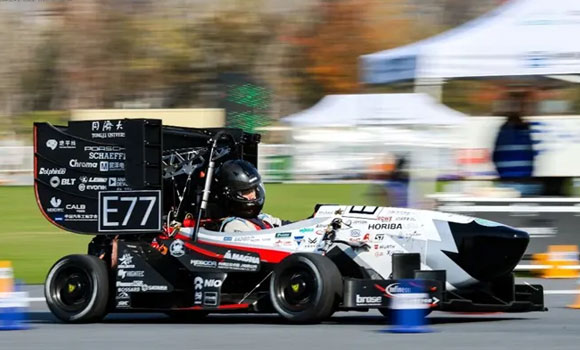
In 2025, Xi’an Bright Laser Technologies Co., Ltd (BLT), China, once again supported teams in Formula Student Electric China (FSEC) and Formula Student Autonomous China (FSAC).
Tongji University secured the national runner-up title, while the Beijing Institute of Technology (BIT) Racing Team earned first prize.
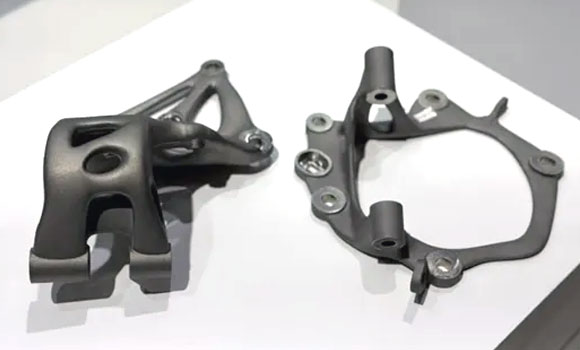
BLT manufactured uprights that bear full vehicle loads and endure complex stress conditions using high-strength aluminium on the BLT-S600 (4-laser) Additive Manufacturing machine in collaboration with the Tongji Electric Racing Team.
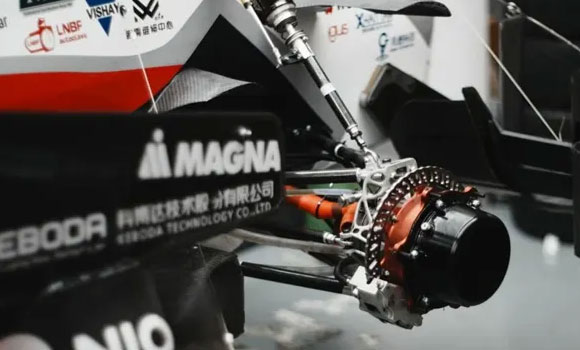
The uprights maintained required strength and stiffness while ensuring interference-free integration with the suspension. Compared with traditionally machined uprights, the front upright achieved a 36.1% weight reduction, and the rear upright 32.8%, significantly enhancing overall vehicle performance.
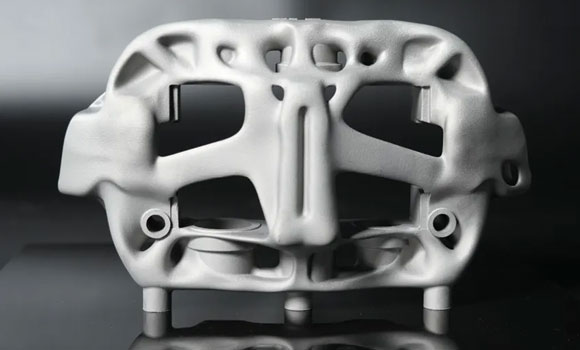
Similarly, for caliper components, BLT engineers applied topology-optimised designs and simulation verification, achieving a maximum simulated stress of only 320 MPa. Compared to purchased conventional components, the front calipers were reportedly reduced in weight by 39.6% and the rear calipers by 48.8%, further contributing to vehicle lightweighting and dynamic performance improvement.
Design freedom in lightweight automotive components
Lightweight design in the automotive industry now extends well beyond powertrains and chassis systems. As electrified vehicles grow heavier due to batteries, electronics, and enhanced safety structures, engineers are increasingly rethinking even conventional components, such as brake calipers and door hinges, as critical opportunities for mass reduction, durability improvement, and performance optimisation.
One example of this shift is BLT’s independently developed titanium alloy brake caliper. Produced using metal AM and optimised through curved-surface topology design, the caliper achieves over 30% weight reduction compared with conventional cast alternatives, while enhancing rigidity, thermal resistance, and load transfer efficiency. Its smooth, integrated contours, difficult to realise through subtractive manufacturing, reflect an approach in which geometry and structural performance are optimised simultaneously. The project also demonstrates BLT’s capability to deliver high-precision, weight-critical components for demanding applications, including optics, where mechanical stability is equally essential.
The same design philosophy extends to BLT’s titanium alloy automotive door hinge, showcased at Formnext 2025. Manufactured as an integrated structure combining functional blades with a lightweight base plate, the hinge is approximately 50% lighter than comparable cast aluminium or iron designs. Beyond weight reduction, the use of high-performance titanium alloy and topology-driven geometry is said to enable smoother load paths, improved fatigue durability, and refined surface quality, illustrating how metal AM is expanding the design space for body-in-white components, where integration, structural integrity, and aesthetics can be achieved without compromise.
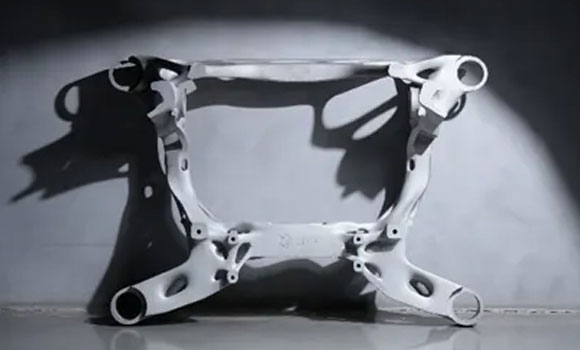
An additively manufactured rear subframe for new energy vehicles
The transition to new-energy vehicles (NEVs) has reportedly created unprecedented demand for structural components that combine low weight, high stiffness, safety performance, and packaging efficiency. In collaboration with an NEV manufacturer, BLT applied metal AM to redesign and manufacture an electric-vehicle rear subframe, one of the largest and most structurally demanding components produced via PBF-LB.
Using bidirectional evolutionary structural optimisation (BESO), BLT engineered a hollow, 2 mm-wall lattice-filled architecture that eliminated stress concentration issues and overcame limitations inherent in casting-based designs. Manufactured in one piece on the BLT-S815 system, which offers a forming volume of 800 × 800 × 1500 mm, the redesigned subframe reportedly achieved a 20% weight reduction while maintaining the required strength and stiffness for vehicle integration.
www.xa-blt.com