BLT achieves high-volume copper AM production milestone
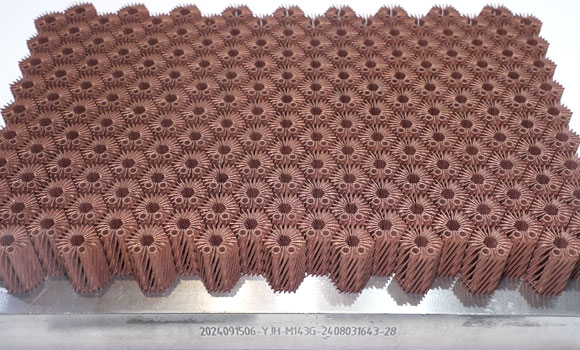
Xi’an Bright Laser Technologies Co, Ltd (BLT), China, has reported a milestone in copper Additive Manufacturing. As of March 2026, cumulative production has exceeded 100,000 components on its BLT-S400 eight-laser Laser Beam Powder Bed Fusion (PBF-LB) Additive Manufacturing machine. The company said this achievement demonstrates the potential for repeatable, high-volume production of copper alloy components.
Copper alloys, valued for their thermal and electrical conductivity, are widely used in optical communications, data centres and electronics thermal management. However, their high reflectivity and thermal diffusivity have historically limited their manufacturability using metal Additive Manufacturing.
According to BLT, these challenges are addressed through a multi-laser configuration designed to increase throughput while maintaining precision. The machine supports both red- and green-laser strategies, enabling processing of different copper alloy compositions. An extended build length of 450 mm reportedly allows increased part density per build, supporting high-volume production of small components such as heat sinks and optical modules.
The company has also developed an integrated workflow covering powder development, process parameter optimisation and post-processing. BLT stated that its approach incorporates experience from high-volume consumer electronics manufacturing, with features such as predictive fault management, continuous operation capability and thermal control aimed at ensuring process stability during extended production runs.
BLT has also introduced automated production line solutions that integrate machine hardware, factory planning and process commissioning. These machines can be configured for semi- or fully automated operation, with the aim of supporting the transition from prototyping to serial production. The company added that its experience in high-volume manufacturing enables customers to accelerate adoption and reduce implementation risks.
Copper Additive Manufacturing offers advantages including reduced material waste, shorter production cycles and increased design freedom for complex geometries. Challenges remain in areas such as process standardisation, cost efficiency and quality assurance. However, recent progress may indicate that copper is moving towards more reliable industrial-scale production. BLT’s reported milestone supports the role of multi-laser machines, process optimisation and automated production in enabling this transition.