amsight releases metal AM powder management whitepaper
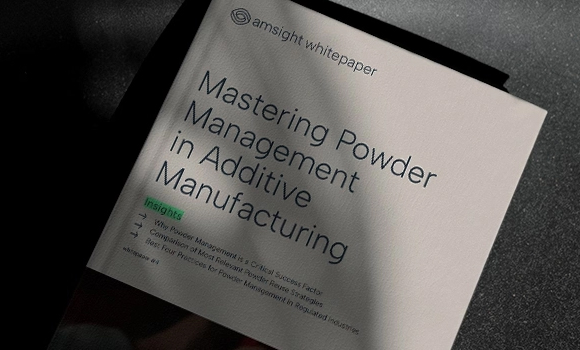
amsight, headquartered in Hamburg, Germany, has published a new whitepaper, ‘Mastering Powder Management in Additive Manufacturing’, examining powder control and its role in quality management for production metal Additive Manufacturing.
The whitepaper considers how metal powder can change through reuse, exposure, handling, sieving, blending and storage. These changes can affect characteristics including chemistry, particle size distribution, morphology and flowability, with potential consequences for part quality, process stability, scrap rates and audit readiness.
Focusing on metal Powder Bed Fusion (PBF), particularly Laser Beam Powder Bed Fusion (PBF-LB), the document examines where variability can enter the powder lifecycle and how powder characteristics may change during reuse. It also considers how powder history can be linked with build, post-processing and inspection data to provide traceable quality records.
“Powder management is often treated as a material-handling task, but in production AM it is a quality-management task,” stated Tim Wischeropp, CEO at amsight. “If teams cannot connect powder history to part outcomes, they cannot reliably understand drift, optimise reuse, or build the evidence needed for regulated production. The goal is not more paperwork. The goal is controlled, queryable quality data.”
The whitepaper compares four powder reuse strategies: single use, fixed refresh ratio, batch method and blending. It considers the implications of each approach for cost, waste, traceability and quality control.
It also outlines approaches for powder management in regulated industries, including centralised documentation, powder traceability, operator qualification, controlled infrastructure and monitoring of relevant powder properties.
A further focus is the use of condition-based controls in place of fixed powder reuse limits. The paper proposes identifying critical-to-quality powder characteristics, linking these with part outcomes, establishing control limits and applying statistical process control (SPC) to identify changes in powder condition.

“Customers are not only asking whether a part conforms,” added Peter Lindecke, CCO of amsight. “They increasingly want evidence that the process behind the part is controlled. Powder is a major part of that evidence chain. This whitepaper is designed to help AM teams understand where their powder data maturity is today and what practical steps they can take next.”
‘Mastering Powder Management in Additive Manufacturing’ is available here.