Addireen upgrades XH-M350G-2HR for series production of pure-copper parts
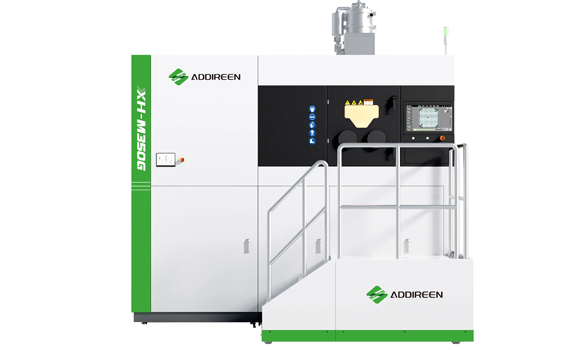
Addireen, based in Shenzhen, Guangdong, China, has introduced the third-generation XH-M350G-2HR, upgrading its green Laser Beam Powder Bed Fusion (PBF-LB) platform for series production of pure-copper parts. Addireen states that the update concentrates on three practical requirements: build efficiency, stability during extended operation, and consistent results across full-build-plate layouts.
The XH-M350G-2HR uses two in-house-developed green lasers, with dual 500 W systems as standard and a dual 1,000 W option. It provides a 350 × 350 × 550 mm build volume, including the build plate, and qualified pure-copper processes at 30, 40 and 80 μm layer thicknesses.
“For our customers, scaling up copper AM means producing more parts per build, sustaining reliable operation over long production cycles and maintaining consistent quality from batch to batch. The third-generation XH-M350G-2HR focuses on these production priorities to help customers scale their pure-copper manufacturing with confidence,” said Yujing Xu, Director of Global Business at Addireen.
For build efficiency, the dual green lasers support pure-copper build rates of up to 24.24 cm³/h at 40 μm under the specified test conditions. Bidirectional variable-speed recoating reduces non-exposure time between layers. Updated purging logic and chamber sealing also shorten preparation.
Addireen states that at room temperature, pure copper absorbs 532 nm green laser light at roughly eight times the rate of conventional near-infrared wavelengths. Higher absorption, combined with a focused 40–60 μm spot, delivers energy more efficiently into the material. This reportedly helps reduce spatter, widens the processing window and supports finer feature resolution. Addireen reports that fine features down to 0.10 mm can be produced, while process development for materials is faster and more straightforward.
For stable long builds, Addireen revised the optical path and key optical components and added active temperature control to limit thermal drift. The changes are intended to maintain laser energy distribution across the build area during extended operation. A two-level airflow system separately clears smoke and spatter from the powder bed and limits particle accumulation near the protective window. Under the recorded conditions, the build-area airflow coefficient of variation was 3%, and protective-window cleanliness was maintained for more than 360 hours. The company states that the XH-M350G series has accumulated more than 100,000 manufacturing hours.
For full-plate consistency, the machine connects motion control, recoating and process monitoring in a closed loop. Linear-scale feedback and servo control maintain the build position, while powder-layer inspection checks recoating quality before exposure. Laser power and build-chamber oxygen concentration are recorded for process review and traceability. For the evaluated production setup, Addireen recorded within-build dimensional consistency of Cpk > 1.33.
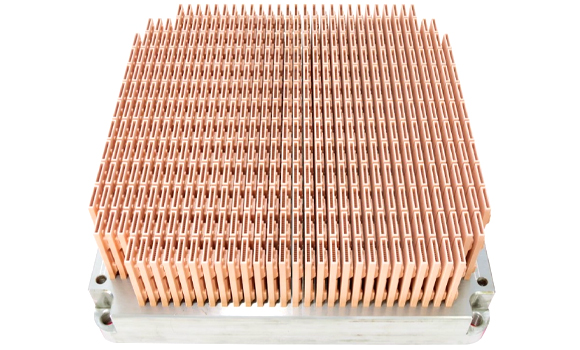
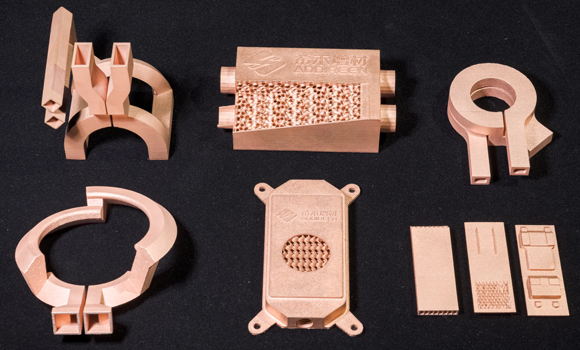
One production build brought these updates together in a full-plate layout of approximately 400 pure-copper heat sinks for optical transceivers. The build ran for about 140 hours and included closely spaced fins and local wall thicknesses below 0.5 mm.
Under defined process conditions, pure copper achieved a 0.1 mm minimum wall thickness, up to 99.9% relative density, 400 W/(m·K) thermal conductivity and 101% IACS electrical conductivity. Results depend on the part and test method.
The XH-M350G-2HR is intended primarily for pure-copper and copper-alloy applications in thermal management and other high-conductivity components. Typical applications include liquid cold plates, heat exchangers, optical-transceiver heat sinks and induction coils. The machine is also suited to CuCrZr aerospace combustion chambers with integrated cooling channels.