Trumpf showcases how Additive Manufacturing can improve satellites and aircraft
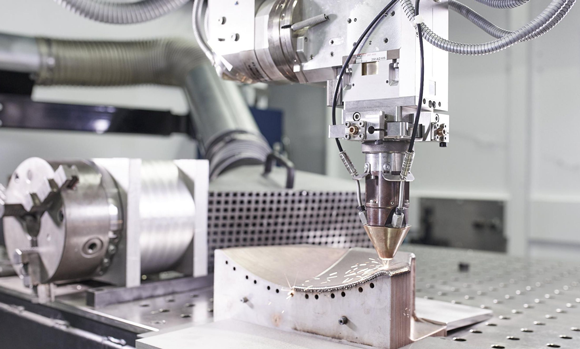
The LMD process shown here on a Trumpf system is suitable for repairing large parts and developing prototypes in the aerospace sector (Courtesy Trumpf)
Trumpf, Ditzingen, Germany, demonstrated how its metal Additive Manufacturing technologies can improve satellites and aircraft at the Paris Air Show, which took place from June 17–23, 2019. Satellites are subject to a range of stringent requirements, and need to be as light as possible, while also being robust enough to withstand the forces experienced during launch – because of this, Additive Manufacturing, with its lightweighting capabilities, can provide a very good solution for the aerospace industry.
Most AM processes are also adept at handling light metals such as aluminium and titanium, as well as offering enhanced design freedoms. Thomas Fehn, Trumpf’s General Manager Additive Manufacturing with responsibility for sales, stated, “With a market share of over 20%, the aerospace sector is one of the world’s most important industrial users of Additive Manufacturing. We are steadily expanding our market share and helping to establish the process as a key technology.”
Trumpf’s metal Additive Manufacturing services include Laser Powder Bed Fusion (L-PBF) and Laser Metal Deposition (LMD), a form of Directed Energy Deposition (DED) Additive Manufacturing. L-PBF technology is particularly suitable for creating complex parts for engines, combustion chambers, specialist aerospace components and similar applications, while LMD is suited to the rapid forming of very large parts, with typical applications including prototype development and repairs to large parts such as gas turbines and compressor blades.
During the Paris Air Show, Trumpf highlighted three examples of how its AM technologies have been used within the satellite and aircraft industries:
- Weight of satellite mounting structure reduced by 55%
Trumpf was commissioned by space company Tesat-Spaceroom GmbH & Co. KG, Backnang, Germany, to produce an additively manufactured mounting structure for Germany’s Heinrich Hertz communications satellite, which will be used to test the space-worthiness of new communication technologies. The mounting structure includes strap-on motors that are used to modulate microwave filters. In collaboration with the company AMendate, Paderborn, Germany, engineers reportedly succeeded in optimising the topology of the mounting structure and reducing its weight by 55%. The mount now weighs just 75 g, compared to the previous 164 g.The team of experts additively manufactured the redesigned part on Trumpf’s TruPrint 3000 AM system. The new geometry cannot be produced using conventional methods. As well as being lighter, the optimised mounting structure is also more robust; during the launch of the satellite, the new mounting structure will withstand the same high forces and is expected to hold its shape better. The Heinrich Hertz satellite mission is being carried out by DLR Space Administration on behalf of the Federal Ministry of Economics and Energy and with the participation of the Federal Ministry of Defense.
- Cost of engine parts reduced by three quarters
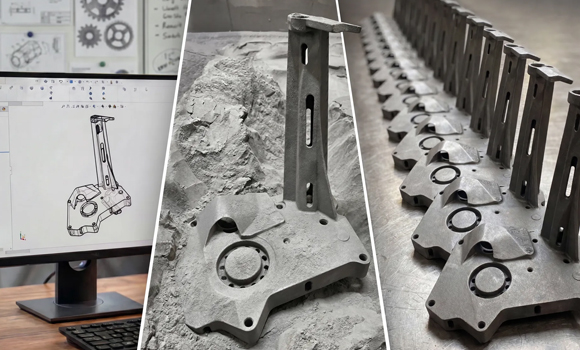
In collaboration with Ramem, Torrejón de Ardoz, Spain, Trumpf employed AM to optimise a part known as a ‘rake’. Manufacturers use this part during engine development to measure the pressure and temperature of the engine. These kinds of measurements are an important part of testing aircraft performance.Mounted directly in the engine’s air flow, rakes are exposed to extreme temperatures and high pressure. To deliver accurate measurements, they must conform to precise dimensional requirements; therefore, producing rakes by conventional means is an expensive and time-consuming process, in which workers must produce the base structure on a milling machine before inserting six delicate tubes, welding them into place and sealing the body of the rake with a cover plate. If just one of these tubes is out of place, the rake has to be scrapped.
Trumpf stated that it produced an optimised rake geometry on its TruPrint 1000 AM system, which makes it quicker for the manufacturer to produce and reduces the amount of material used by around 80%, ultimately reducing the overall cost by 74%. “This result shows that 3D printing can save a significant amount of time, material and money in the aircraft industry,” reported Julia Moll, Project Manager from Trumpf Additive Manufacturing.
- Making engine blades easier to repair
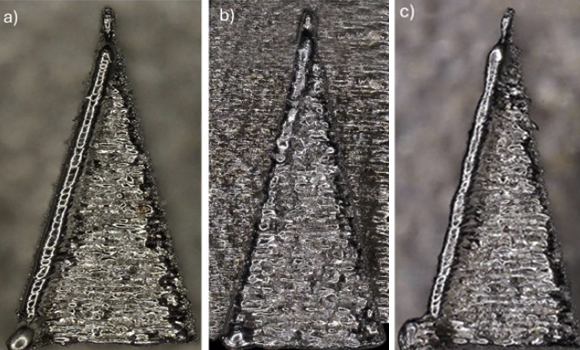
Trumpf also presented sample applications for its LMD technology, which included the LMD repair of a high-pressure compressor blade used in aircraft engines. The company explained that these components have to withstand extreme changes in temperature during flight and are in constant contact with dust and water, and therefore typically show signs of wear on the edges and tips.Aviation engineers must periodically repair the blades to maintain engine efficiency, and the LMD method is reported to be well-suited to this job. In some sections of the blades, the material is just 0.2 mm thick; conventional methods quickly reach their limits in these kinds of applications. With LMD technology, the laser can be positioned with an accuracy of approximately one hundredth of a millimeter before it applies a precisely calculated dose of energy. At the same time, the system deposits material of exactly the same composition as the part itself.
Depending on the application, LMD repairs can take just a few minutes, and make it easy to repair blades multiple times, significantly reducing the cost-per-part in each engine overhaul. Oliver Müllerschön, Head of Industry Management Laser Production Technologies at Trumpf, reported, “Laser Metal Deposition delivers a low dose of energy – and that makes it perfect for aerospace applications. We can use it not only to repair and coat parts, but also to build up three-dimensional structures. That’s simply not possible with conventional welding methods.”