3D Systems teams with Airbus Defence and Space to produce metal AM satellite RF filter
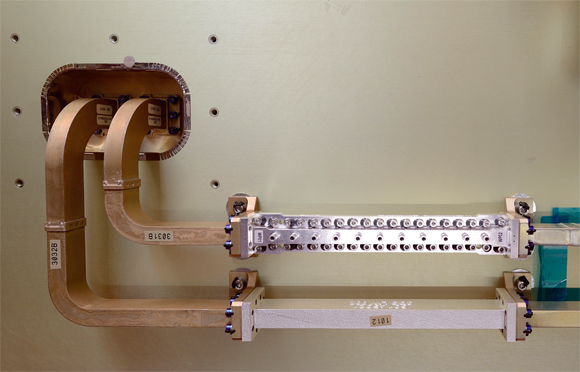
The first flightworthy metal additively manufactured radio frequency (RF) filter for a telecommunications satellite (Courtesy 3D Systems)
3D Systems’ Leuven division, Belgium, has partnered with Airbus Defence and Space in Stevenage, UK, to deliver what it states is the first flightworthy metal additively manufactured radio frequency (RF) filter for a telecommunications satellite. According to 3D Systems, the use of metal Additive Manufacturing allowed the companies to achieve a weight reduction of 50% compared to traditionally manufactured RF filters.
Metal RF or waveguide filters have been in use since the introduction of space communication systems nearly fifty years ago. RF filters act as ‘wave guides’ by allowing frequencies from selected channels to pass through, and rejecting frequencies from signals outside those channels. High-capacity telecommunication satellites can sometimes carry as many as 500 RF filters incorporating more than 600 waveguides, many of which are custom-designed to handle specific frequencies.
3D Systems’ metal additively manufactured RF filter was developed with funding from the European Space Agency as part of its project on the ‘Modelling and design of optimised waveguide components utilising 3D manufacturing techniques’. News of the successful testing and validation of this part follows a trend of increasing metal AM use in the aerospace industry, with the technology rapidly making steps from prototyping to production parts and assemblies ready for flight.
The major goal of this project was to increase the performance, production efficiency and customisation capabilities for RF filters on modern telecommunications satellites, and to produce a part which would pass the rigorous testing imposed by Airbus Defence and Space. Sending a satellite into geo-stationary orbit can cost as much as $20,000 per kilogram of its weight; therefore, every new satellite part designed must also be as light as possible.
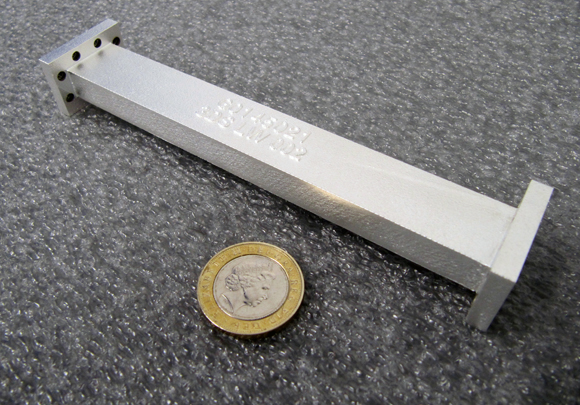
The new RF filter, with coin for size comparison (Courtesy 3D Systems)
3D Systems developed the new RF filter for production in its ProX® DMP 320, a laser powder bed Additive Manufacturing system which it refers to as a Direct Metal Printer. As well as achieving a 50% weight reduction, the company was able to consolidate the filter from two parts into one, improve its functionality by incorporating an internal structure not possible to manufacture via traditional means, reduce production time and lower production costs for customised designs.
RF filters have traditionally been designed using libraries of standardised elements dictated by the limitations of the manufacturing process, such as rectangular cavities and waveguide cross-sections with perpendicular bends. Using manufacturing processes such as milling and spark eroding, these shapes have traditionally been achieved by machining each RF filter in two halves, which are then bolted together. This increases weight, adds an assembly step to production time and requires additional quality assessment.
In designing the part for AM, 3D Systems and Airbus Defence and Space were able to explore complex geometries at no additional manufacturing cost. The new RF filter design features an internal structure based on a series of depressed super-ellipsoidal cavities. According to 3D Systems, this unique internal structure, which could not have been achieved through traditional manufacturing techniques, enables the part to channel and reject RF currents of different wavelengths with the minimum energy loss possible.
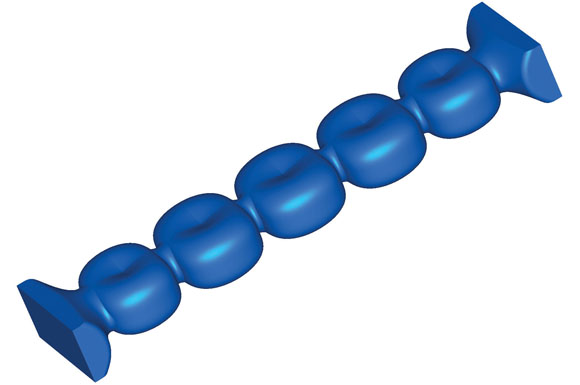
The new RF filter design features an internal structure based on a series of depressed super-ellipsoidal cavities (Courtesy 3D Systems)
In some cases, the difference in surface topology between metal additively manufactured and traditionally manufactured parts may be a concern. While the microscopic topology of machined parts usually includes sharp peaks and troughs, the spherical powders used in metal AM result in a smoother, ‘waved’ topology, as opposed to steep transitions. However, after x-ray CT scanning by Airbus Defence and Space, the metal AM RF filter was reported to have a good general surface quality for its purpose, with the advantages of its internal structure outweighing any potential disadvantages posed by its surface topology.
During testing to mimic the conditions an RF filter would face during launch and in orbit, including vibration, shock, temperature extremes and vacuum conditions, Airbus Defence and Space reported that all test samples exceeded requirements, with the best performance coming from an RF filter which was silver-plated via an electrolytic process after manufacturing.
Paul Booth, RF engineer for Airbus Defence and Space, stated, “The success of this project opens up the possibility of much greater integration of RF filters with mechanical and thermal components to reduce part count and overall mass. We will also look at integrating more functionality, such as test-couplers, as part of the filter or directly integrated into waveguide runs. There is a huge potential here for reducing mass while cutting production time and costs.”