NPS tests shipboard Additive Manufacturing and metal powder production at RIMPAC 2026
A team of nine students from the Naval Postgraduate School (NPS), Monterey, California, USA, participated in Rim of the Pacific (RIMPAC) 2026, taking graduate research into an operational environment. Supported by nearly a dozen faculty members and researchers, much of the work was led by NPS’ Consortium for Advanced Manufacturing Research and Education (CAMRE).
A key focus was shipboard Additive Manufacturing and the development of a complete manufacturing workflow at sea.
US Navy Ensign William Schleper, a student in the NPS Department of Mechanical and Aerospace Engineering researching advanced manufacturing alloys, served as officer in charge of CAMRE’s Additive Manufacturing team aboard the aircraft carrier USS Theodore Roosevelt (CVN 71) and MV Asterix (A147).
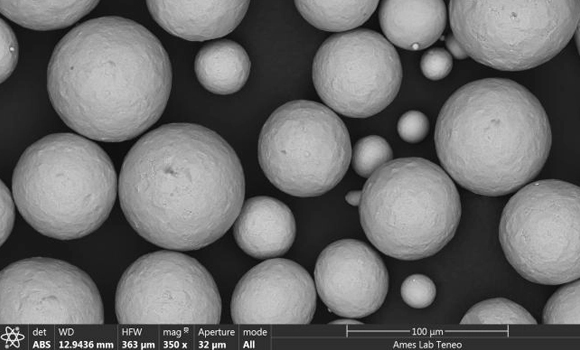
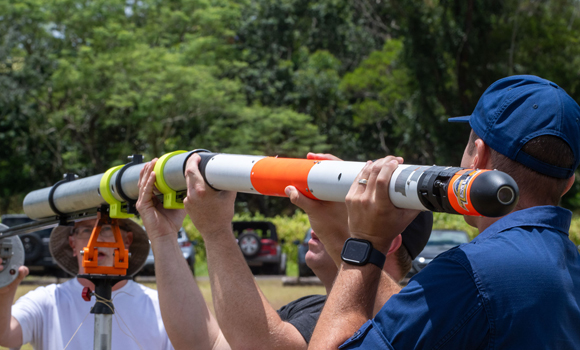
Schleper coordinated personnel, equipment and shipboard integration activities and operated a Metal Powder Works M-175 machine capable of producing metal powder from bar stock at sea. The team also demonstrated several Additive Manufacturing technologies as part of an effort to evaluate a complete shipboard manufacturing workflow.
Moving the work from a controlled laboratory to an operational ship introduced conditions that are difficult to reproduce in an academic environment, including ship movement, heat, equipment placement, power requirements, safety restrictions, communications and logistics.
“In a laboratory, we generally have stable power, controlled environmental conditions, readily available tools, and relatively unrestricted access to equipment,” Schleper said. “At sea, those assumptions no longer hold.”
“That experience gave me a much better understanding of the difference between demonstrating that a technology works in a laboratory and demonstrating that it is actually useful and sustainable for the fleet,” he added.
The experience also changed how Schleper views individual Additive Manufacturing machines within the wider production process.
“Instead of viewing the printer as an isolated piece of equipment, I now think much more about the complete manufacturing system: raw material, feedstock production, printing, post-processing, inspection, and ultimately getting a usable component into the hands of the operator,” Schleper said.
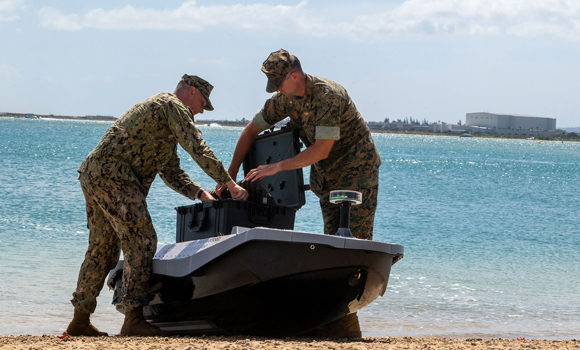
That wider workflow extended to autonomous logistics. US Navy Lt Evan Humphreys, an NPS mechanical engineering student, supported CAMRE’s work transporting components using unmanned surface vessels (USVs).
Humphreys coordinated operations involving CAMRE, USS Essex (LHD 2), Theodore Roosevelt and Asterix, as well as industry partners Splash and HavocAI. During the exercise, USVs were launched and recovered from shore and ships and used to transport components between operating locations.
Humphreys supported operations involving Splash’s Typhoon and HavocAI’s Kaikoa vessels, including an operation in which the Typhoon was brought aboard Essex through the ship’s stern gate.
“The operations showed me that technology has progressed to the point where uncrewed systems can be relied upon to transit independently and arrive at a designated rendezvous point on time,” Humphreys said.
Together, the manufacturing and logistics work enabled NPS students to examine not only whether Additive Manufacturing technologies could operate at sea, but how feedstock, production and component delivery could function as part of a broader shipboard manufacturing workflow.
The students’ participation formed part of a broader NPS presence at RIMPAC involving researchers and faculty from multiple academic departments and collaboration with military, government, academic and industry partners.