RMIT develops buoyant PBF-LB titanium lattice for marine applications
ApplicationsNewsResearch
September 8, 2026
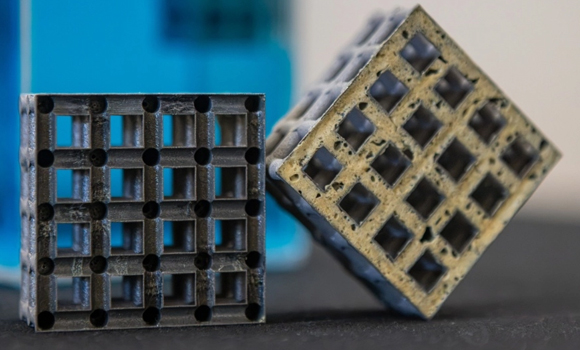
An RMIT prototype buoy incorporating the PBF-LB Ti-6Al-4V hollow-strut lattice developed for buoyant marine structures (Courtesy Sara Tan, RMIT University)

Researchers at RMIT University, in Melbourne, Australia, have developed a buoyant titanium structure produced using laser beam Powder Bed Fusion (PBF-LB) that is intended to retain buoyancy even when damaged.

The structure combines additively manufactured Ti-6Al-4V hollow-strut lattices with polyurethane foam filling the internal channels. The approach is intended to combine the strength and corrosion resistance of titanium with a lightweight architecture capable of maintaining buoyancy following localised structural damage.
The researchers designed the lattice with hollow struts rather than relying on sealed external cavities for buoyancy. Polyurethane foam is introduced inside the interconnected hollow channels, providing distributed buoyancy throughout the structure. According to the researchers, this means cracking or damage to one area does not necessarily allow water ingress to compromise the complete structure.

Mechanical testing showed that the architecture could remain buoyant following significant damage, including the failure of an entire lattice layer. At an equivalent overall density, the titanium-polyurethane lattice was reported to be around 70% stronger than stainless steel or high-density polyethylene (HDPE).
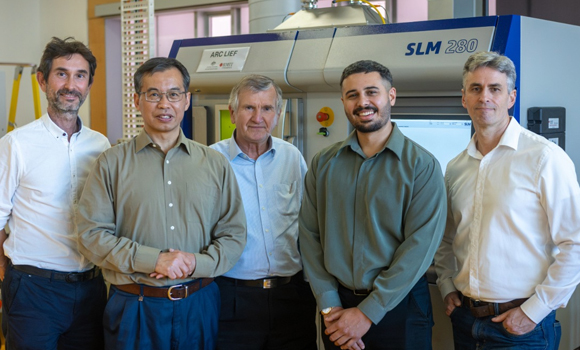
Professor Andrey Molotnikov, Distinguished Professor Ma Qian, Distinguished Professor Milan Brandt, Dr Jordan Noronha and Professor Martin Leary at RMIT's Centre for Additive Manufacturing (Courtesy Sara Tan, RMIT University)
Professor Andrey Molotnikov, Distinguished Professor Ma Qian, Distinguished Professor Milan Brandt, Dr Jordan Noronha and Professor Martin Leary at RMIT’s Centre for Additive Manufacturing (Courtesy Sara Tan, RMIT University)

The researchers also investigated its performance in a marine environment. Following two weeks of exposure to natural seawater, the material reportedly showed approximately 0.15% mass loss and less than a 1% reduction in strength.

As part of the study, the team produced a prototype buoy incorporating the PBF-LB titanium structure and demonstrated it in turbulent seawater. The researchers see potential applications for the technology in marine structures and offshore infrastructure, particularly where conventional buoyant materials may be vulnerable to damage or degradation.
The combination of PBF-LB and lattice design also allows the geometry, wall thickness and distribution of material to be tailored to different structural requirements. The researchers state that the approach could therefore be adapted for applications ranging from floating platforms and offshore energy infrastructure to deep-sea equipment.

Further work is planned to manufacture larger demonstration components and assess the structures under longer-term, realistic marine and deep-sea conditions. The team is also seeking industry partners to support scale-up and application development.

The study ‘Breaking the surface: buoyant metal–polymer open–cell hybrid lattice metamaterials’ was published in Advanced Materials.
www.rmit.edu.au

GET THIS ISSUE:  PDF  |  VIEW ONLINE  |  BUYER’S GUIDE
ApplicationsNewsResearch
September 8, 2026

TRUSTED CONTENT. TARGETED AUDIENCE

Advertise with Metal AM and access a global base of 50,000+ AM professionals.

Contact Jon Craxford: [email protected]

Request a Media Pack
  • AM machines
  • Process monitoring & calibration
  • Heat treatment & sintering
  • HIP systems & services
  • Pre- & post-processing technology
  • Powders, powder production and analysis
  • Part manufacturers
  • Consulting, training & market data

Don’t miss a thing – register for our newsletter

Don't miss any new issue of Metal AM magazine, and get the latest industry news. Sign up to our twice weekly newsletter.

Register now

Join 40,000+ other AM professionals – follow us online

About Metal Additive Manufacturing magazine

Metal AM magazine, published quarterly in digital and print formats, is read by a rapidly expanding international audience.

Our audience includes component manufacturers, end-users, materials and equipment suppliers, analysts, researchers and more.

In addition to providing extensive industry news coverage, Metal AM magazine is known for exclusive, in-depth articles and technical reports.

Our focus is the entire metal AM process from design to application.

Each issue is available as an easy-to-navigate digital edition and a high-quality print publication.

Discover our magazine archive…

The free to access Metal Additive Manufacturing magazine archive offers unparalleled insight into the world of metal Additive Manufacturing from a commercial and technological perspective through:

  • Reports on visits to leading metal AM part manufacturers and industry suppliers
  • Articles on technology and application trends
  • Information on materials developments
  • Reviews of key technical presentations from the international conference circuit
  • International industry news

All past issues are available to download as free PDFs or view in your browser.

Browse the archive

Share via
Copy link
Powered by Social Snap