Ferrita customises SLR McLaren exhaust using Meltio Robot Cell
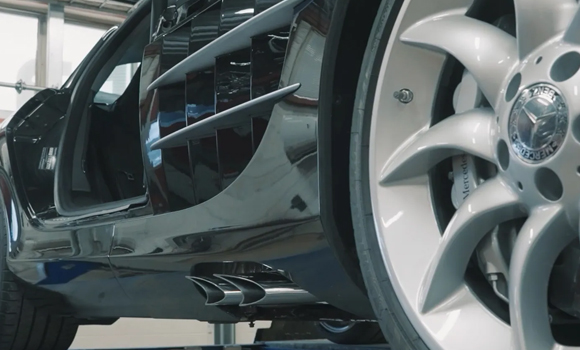
Ferrita Sweden AB, based in Köping, Sweden, has worked with Meltio, headquartered in Linares, Spain, to produce custom aftermarket parts for a 2003 Mercedes-Benz SLR McLaren. The team needed to replace the original muffler, a relatively heavy component weighing around 20 kg, to save weight and reduce excess heat.
Producing customised automotive components using traditional subtractive or forming methods can lead to high costs and production bottlenecks. For this specific build, Ferrita needed to manufacture four symmetrical exhaust tailpipes. Traditionally, achieving the required symmetry would require the shop to create special tooling at great expense.
Furthermore, aftermarket fabrication shops often operate under tight deadlines. Ferrita usually only has the customer’s car in the shop for about a week. Therefore, everything from the initial idea to the final manufactured part must proceed rapidly. Dedicating weeks and extensive budgets to custom tooling does not align with the workflow required in high-tier automotive customisation.
With the Mercedes-Benz SLR McLaren project, the most immediate challenge was designing the components to perfectly match the existing lines of the vehicle, as the exhaust system fits tightly inside the front wing (fender). Beyond physical fitment, the team also faced complex fluid dynamics challenges. Creating an ideal exhaust note requires precise manipulation of pipe dimensions, volumes, frequency changes, and exhaust velocity. The shop needed a manufacturing method that could deliver flawless internal geometries to reduce backpressure, all while adhering to a rigid one-week turnaround.
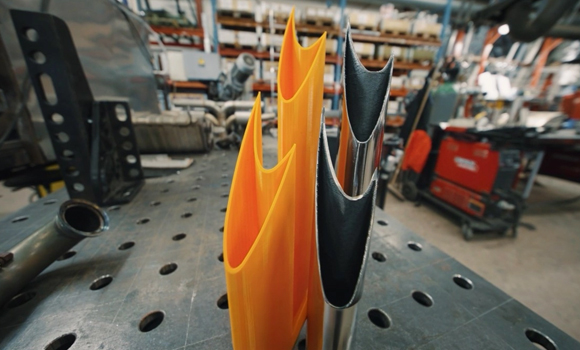
Ferrita started by scanning the bottom plate to visualise the exact space they had to work with, establishing a digital concept model to test fitment for the valves and pipes. Before using any metal, they additively manufactured a plastic prototype in just a few hours to guarantee the design matched the car’s lines.
For final production, Ferrita used a Meltio Robot Cell. This Additive Manufacturing machine combines an ABB robot with Meltio’s Laser Metal Deposition (LMD) technology, a laser-based wire Directed Energy Deposition (DED) process that uses nine 1000-watt lasers. The tailpipes were manufactured out of 316 stainless steel in approximately four to five hours.
Utilising the Meltio Robot Cell removes standard manufacturing bottlenecks, allowing fabrication shops to achieve mass production quality and exact repeatability on bespoke components. The AM machine can handle multiple materials in a single build; for example, it can start with Inconel closest to the turbo and then switch to stainless steel.