RIT PhD graduate explores zinc for AM facial implants
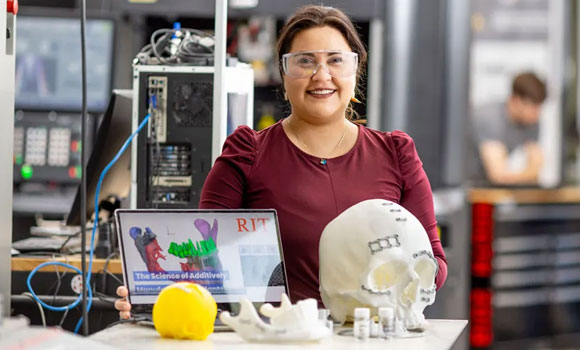
Rochester Institute of Technology (RIT), New York, USA, has reported on doctoral research by Valeria Marin Montealegre exploring the use of zinc-based materials in Additive Manufacturing for facial bone implants.

Marin Montealegre began her work in Colombia, where she co-founded HumanBX, a company developing custom implantable devices. During this time, she was involved in surgical case planning and implant design, gaining experience in product development and manufacturing processes.
Seeking to expand her knowledge of materials science and Additive Manufacturing, she enrolled at RIT in 2021. In 2022, she began a PhD in Mechanical and Industrial Engineering, working under the supervision of Denis Cormier, director of the AMPrint Center.
Her research focuses on the use of zinc as a biocompatible metal for medical applications. Zinc-based materials are of interest due to their potential to provide temporary mechanical support during healing while gradually degrading as new bone forms.

A key area of investigation is the use of Molten Metal Jetting (MMJ), an Additive Manufacturing process in which molten metal droplets are deposited to build components layer by layer. The work also explores lattice structures, which can be used to tailor mechanical properties and support bone in-growth.
According to Marin Montealegre, there are currently limited research efforts focused on processing bio-metals using MMJ. Her work aims to address this gap by evaluating how zinc can be processed using this approach and how resulting structures perform in biomedical contexts.
By 2023, her research had expanded to include process development and material behaviour in zinc MMJ, with ongoing work focused on optimising structure and performance for implant applications.
Following completion of her PhD, Marin Montealegre plans to further develop HumanBX, with the potential to expand clinical research and manufacturing activities internationally.