NREL installs large-scale metal AM machine for marine energy research
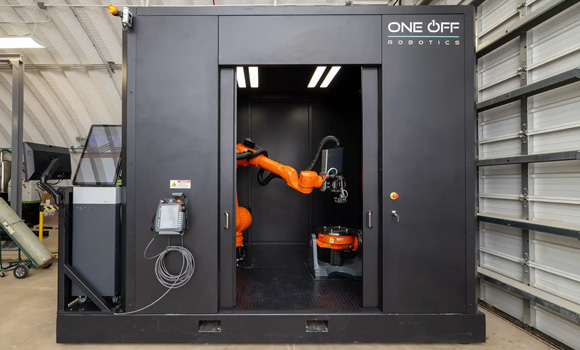
NREL, the US Department of Energy’s primary national laboratory for energy systems based in Golden, Colorado, has installed a new laser-powered metal Additive Manufacturing machine at its Flatirons Campus. The Directed Energy Deposition (DED) AM machine can quickly produce metal components for marine energy devices, allowing researchers to test the metal’s durability with minimal cost and waste.
Withstanding the powerful, often destructive forces of ocean waves is critical for marine energy devices, which are designed to generate energy from waves, currents, and tides. “Compared to plastic, metal components can withstand five to ten times as much force,” said Paul Murdy, a mechanical engineer at NREL.
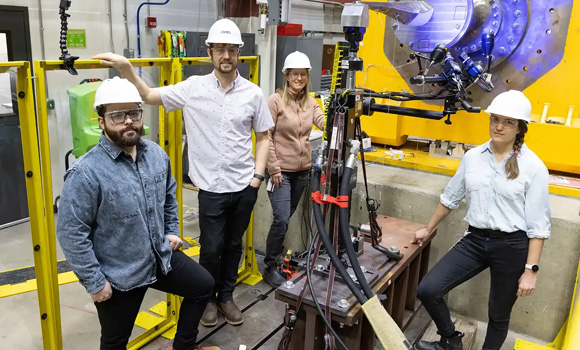
“We have a good amount of experience doing rapid prototyping and Additive Manufacturing with smaller machines,” added Casey Nichols, an NREL research engineer who works with Murdy to design, build, and test novel marine energy technologies. “But getting a larger 3D printer lets us do more at-scale research.”
The team can now quickly determine whether a specific component benefits from metal Additive Manufacturing. They can also easily build and trial whole, full-scale prototypes, including those with unusual geometries, so developers can rapidly confirm their device’s strength and move it closer to commercial success.
The new machine can also help researchers outside marine energy produce essential components for a variety of technologies, including water heaters, shipping or naval vessels, and aerospace tech, and produce parts in days, bypassing the six-to-nine-month waiting period to purchase parts from dominant overseas markets.
A machine for marine energy maturation
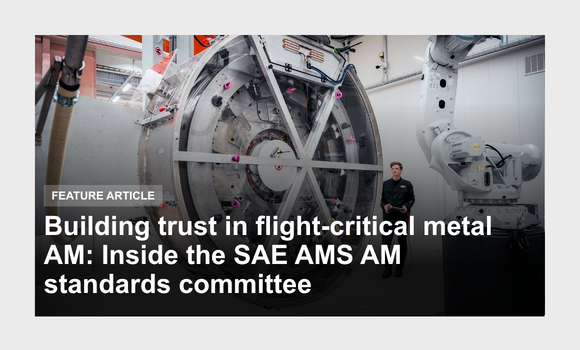
NREL already owned a small fleet of desktop-sized AM machines, but the new machine, which was customised by Tennessee company One-Off Robotics and procured with funding from the US Department of Energy, can build near-full-scale structures up to one metre long.
To operate the machine, researchers use a robotic tech pendant to monitor the code that runs its robotics and lasers. This step helps ensure that the machine produces high-quality metal parts, including some that are typically too complex for conventional AM machines to produce.
“There’s a whole realm of possibilities for very complex metal part design that, until now, has been very hard for researchers to achieve,” Nichols said.
The new machine has eight axes, compared to most conventional AM machines’ three, allowing it to manufacture larger volumes and a wider variety of both conventional and unconventional shapes.
Nichols plans to use the machine to research different marine energy device designs, as well as more efficient and cost-effective methods to manufacture such devices.
Material differences
Murdy, who has worked with Nichols in NREL’s Composites Manufacturing Education and Technology facility for more than six years, is focused less on manufacturing and more on materials. Specifically, he is working to understand which materials thrive best in different marine environments, including those that are especially salty, energetic, cold, or full of fast-moving debris.
“We need to work with metals because of their strength and corrosion resistance,” Murdy said.
Murdy’s metal of choice is stainless steel, but this is not easy to melt or manipulate.
The lasers in the new AM machine must reach temperatures of at least 1371°C (2,500°F), or as hot as the hottest magma. After the 1.2-kilowatt laser melts the metal, those droplets are then deposited in layers that bind and cool quickly. As the machine can rotate and tilt, Murdy and colleagues can create unusual shapes that cannot be easily replicated with conventional subtractive manufacturing processes.
This customisation is critical for an industry like marine energy, where devices must be optimised for their environment. The forces exerted on something like an underwater tidal turbine can vary widely depending on whether it is installed on a calm seabed or an energetic riverbed.
“For example, you could design tidal turbine blades to work under certain flow conditions,” Murdy said, and adapt the design to perform optimally in different water speeds.
Nichols also hopes to identify designs that could lower the cost to produce a device or increase a blade’s structural integrity, two goals that would leverage NREL’s deep expertise in tidal energy.
While the new AM machine offers benefits, such as fast production for fast prototyping, the manufacturing process can also affect a material’s performance. That is why Murdy is keen to assess both individual components and whole devices. “My project takes a holistic approach to understanding everything from design, manufacturing, and through to deployment,” Murdy said. “I’m exploring that whole space to understand where this technology is the most valuable and the bounds of how we can use it.”
Beyond marine energy
Both Murdy and Nichols are focused primarily on helping marine energy technologies achieve commercial success. But the new metal AM machine could also build critical components for shipping and naval vessels, heat exchangers, air and spacecraft, automobiles, and equipment used to make or process pharmaceuticals, food, and cosmetics.
The machine can be used by both NREL researchers and the laboratory’s industry partners to perfect parts for a wide range of technologies.
“NREL is very unique,” Murdy said. “We often have very specialised needs for one-off components that we need manufactured.”
For example, one internal team is researching how to build more efficient water heaters, and the new AM machine could help them rapidly design, build, and test new components.
Charles Candon, NREL research, stated, “Before the lab welcomed our new rapid prototyping machine, our team often had to wait up to nine months to get just one metal part. With a system like this, you can get that part in a matter of days.”
“There’s very little casting and forging in the United States right now,” Candon said. “With a system like this, you can get that part in a matter of days.”
Metal casting is still preferable to AM when a company must produce equipment in bulk, for example, fabricating 10,000 parts at once. But AM wins out in rapid prototyping and when global supply chains are not reliable, according to Candon. “During a supply shortage, this can be an efficient way of producing lower volumes of things,” Candon said.
AM can also reproduce legacy components no longer available through conventional manufacturing. According to the National Hydropower Association, some hydropower components, like steel runners, are only produced overseas and can take years to arrive. That can cause facilities to lose precious income and communities to lose precious energy.