Farsoon and Tekna collaborate to industrialise coarse Ti64 for PBF-LB
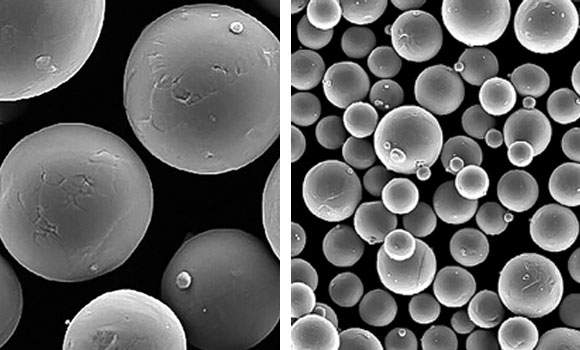
Farsoon Europe GmbH, based in Sindelfingen, Germany, has extended its collaboration with Tekna Holding ASA, headquartered in Sherbrooke, Quebec, Canada, to support the industrialisation of coarse Ti-6Al-4V powders in Laser Beam Powder Bed Fusion (PBF-LB) Additive Manufacturing. The development addresses market demand for increased productivity, improved powder handling, safety and reduced cost per part.
Farsoon’s open-platform approach enables users to extend process parameters beyond conventional limits. By combining coarse powder with thicker layer deposition, the companies report that build times can be reduced while maintaining process stability.
Tekna’s plasma atomisation technology enables the production of both coarse and fine powder fractions from the same source. This allows users to qualify multiple process strategies more efficiently, reducing material approval requirements and lowering overall industrialisation costs.
Fine powders typically used in PBF-LB Additive Manufacturing, however, are often classified as flammable and can require complex safety measures which increases operational costs. Tekna’s coarse Ti64 powder (TEKMAT Ti64-90/45) is said to offer lower oxygen sensitivity, enabling safer handling, recycling, storage and transport. This supports industrial-scale deployment by reducing both risk and cost throughout the powder lifecycle.
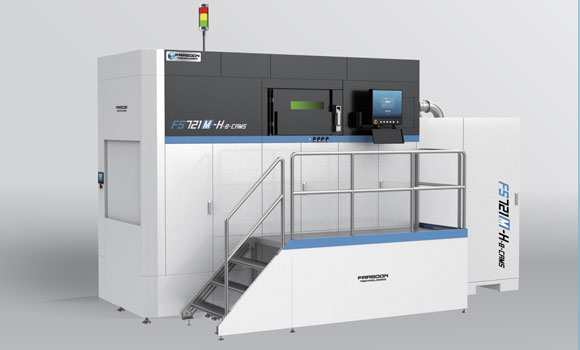
Testing on the FS273M-2 and FS721M-H-8-CAMS systems at a 90 μm layer thickness has shown that, despite the increased layer thickness, as-built Ti-6Al-4V mechanical properties remain aligned with standard PBF-LB benchmarks. These include yield strength of ≥ 850 MPa and ultimate tensile strength of ≥ 900 MPa.
Compared to a typical 60 μm layer thickness, the theoretical build rate increases by more than 20%, contributing to higher machine productivity and lower manufacturing costs.
Shaped-beam technology for increased throughput
Farsoon is further developing its process capability through shaped beam technology, moving beyond conventional Gaussian beam exposure. Shaped beams enable larger and adjustable spot sizes, customised energy distribution and improved melt pool stability at increased layer thicknesses.
This approach is reported to support the reliable processing of coarse powders and enables a significant increase in productivity. By combining thicker layers with shaped beam exposure, the theoretical build rate per laser can increase by more than 80% compared to processing at 90 μm with a Gaussian beam.
The company states that shaped beam technology is a key enabler for series and mass production, supporting the transition of PBF-LB from prototype-focused applications to economically viable serial production.