EWI highlights its Wayland Calibur3 Electron Beam Powder Bed Fusion technology
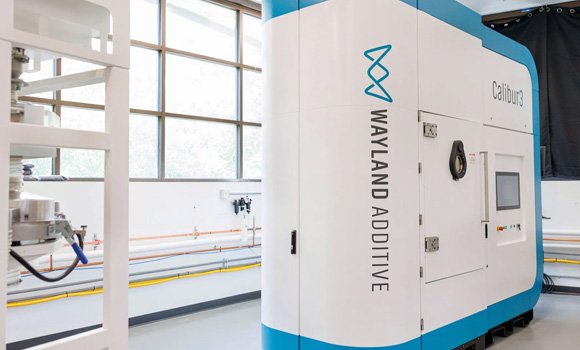
EWI, based in Columbus, Ohio, USA, is highlighting the availability of its Wayland Additive Calibur3 Electron Beam Powder Bed Fusion (PBF-EB) Additive Manufacturing machine based at its Buffalo Manufacturing Works facility. EWI stated that it is currently the only organisation in the US with access to this technology.
Wayland’s NeuBeam process is said to remove a major barrier to process stability, enabling faster manufacturing, cleaner parts, expanded material options, and more efficient powder workflow.
Unlike laser systems that use mechanically controlled mirrors, the Calibur3 steers its high-energy electron beam magnetically, allowing for fast, precise control. This beam can reportedly move orders of magnitude faster than a laser, while also delivering greater energy transfer and deeper penetration.
The PBF-EB capability is reported to support higher-temperature builds, larger layer heights, and tighter control over material microstructure. As the process operates under a vacuum, it also reduces oxidation and allows for more consistent results with sensitive materials.
While PBF-EB can offer numerous benefits, its adoption has historically been limited by one critical issue. During traditional builds, the electron beam imparts a negative charge on the powder. Over time, the charge builds up and can cause the powder to scatter mid-build. These events, known as “smoking,” can ruin a build and contaminate the chamber.
To avoid this, conventional systems sinter the entire powder layer before melting the part geometry. This approach reduces the chance of smoking but comes with major drawbacks. It makes powder recovery difficult, increases post-processing time, and limits design freedom.
Wayland’s NeuBeam technology is said to solve this problem by actively neutralising the charge buildup during the build process. It introduces a small amount of positively charged argon ions into the chamber, which cancel out the negative charge on the powder.
This innovation is said to eliminate the need to sinter full powder layers and reportedly reduces the risk of smoking events.
The result is a cleaner, more efficient, and more scalable PBF-EB process. EWI has already validated the benefits of charge-neutral manufacturing. It has reportedly completed dozens of successful builds using recycled powder with minimal degradation. This is a critical step toward more sustainable, cost-effective Additive Manufacturing.
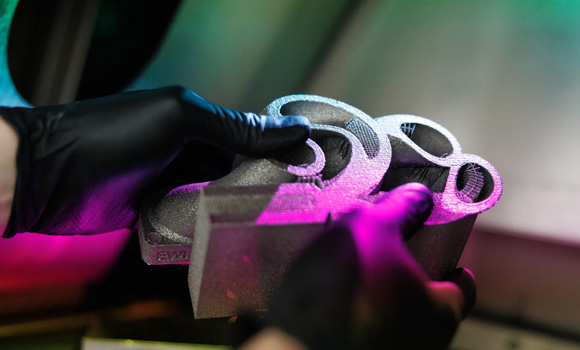
The Calibur3 machine at EWI has already demonstrated its ability to process both conventional and advanced materials, including:
- Molybdenum (Mo): A refractory metal with high-temperature capabilities and challenging processing characteristics. Using the Calibur3, EWI achieved near full density prints with minimal porosity.
- Ti64 (Titanium alloy): One of the most common materials in aerospace. EWI produced high-strength parts with complex geometry.
- C103 (Niobium alloy): A material currently under evaluation as part of our ongoing development roadmap.
As the machine does not require full-layer sintering, part removal is much easier, and internal features can be more complex. Powder recovery is also cleaner and more efficient, reducing waste and improving cost-effectiveness.
The team at EWI is using this technology to develop proof-of-concept builds with new alloys, optimise microstructure control through build parameters, as well as evaluate recyclability and build consistency for real-world production.