CFPR uses Meltio hybrid metal AM to embed crystal seeds in platinum
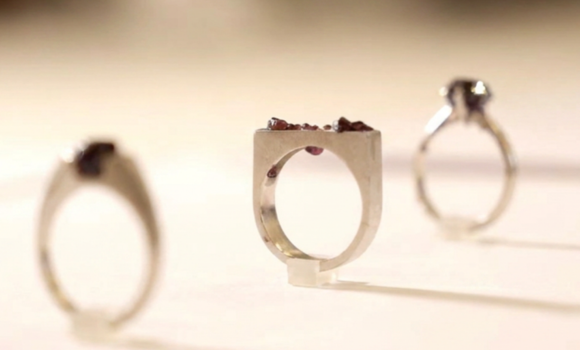
At UWE Bristol’s Bridge Studios, researchers from the Centre for Print Research (CFPR) used a hybrid metal Additive Manufacturing and CNC machining setup – incorporating technology from Meltio, Linares, Spain – to address an unusual jewellery-manufacturing challenge: placing a crystal seed inside a solid metal structure while it was still being built.
The work formed part of CFPR’s neo-gemstone project, led by researcher Sofie Boons, which explored the cultivation of rubies and sapphires directly within platinum settings. Rather than using mined gemstones or stones grown separately before being set, the project used residual material, offcuts and waste from existing gemstones as seeds for new crystals.
For the approach to work, each seed had to be positioned accurately within a metal structure designed to support subsequent crystal growth and to withstand fabrication. Casting, Powder Bed Fusion (PBF) and other methods previously investigated by CFPR did not provide the required combination of access and control.
The use case was developed jointly by UWE Bristol, Meltio partner 3DGBIRE and the CREATE Education Project.

The manufacturing challenge
According to the project teams, gemstones used in jewellery typically reach the market through one of two routes: they were mined from the ground or grown in energy-intensive industrial facilities. In the latter case, traceability over what went into a stone could become difficult to maintain through the supply chain. Neither route aligned with a research group seeking to establish a documented, low-impact origin for gemstones.
CFPR’s alternative used leftover crystal material as a seed and grew the gem directly inside a piece of jewellery. This depended on physically positioning the seed exactly where it needed to sit inside a metal part before fabrication was complete. If the placement was incorrect, the gem could not grow as intended; if the seed was damaged during fabrication, the same applied.
Investment casting, the traditional route for platinum jewellery, involves pouring molten metal into a ceramic mold formed around a wax pattern that was burned out before the pour. Even without a seed involved, fine or open geometries could present challenges. Shrinkage as the metal cooled and variability between pours could affect repeatability, while a failed attempt required the wax pattern to be recreated and the process restarted.
The process was intended to create a shape, rather than hold a delicate object in a fixed position while liquid metal flowed around it. Seeds placed inside a mold could be displaced by metal flow or buoyancy, or damaged by the thermal shock of the pour. Platinum added further difficulty: its high melting point placed greater demands on the casting process and mold system and could complicate subsequent mold removal, while a failed cast in such a valuable metal represented a significant material loss.
Powder Bed Fusion presents a different limitation. During the build, the part remained within a bed of loose metal powder and was not readily accessible until the process had finished. This meant there was no practical way to access the part during the build, place a seed at a specified depth and orientation, and then continue building around it.
CFPR therefore needed a process that could be interrupted during the build, offered sufficient control to position the seed accurately and enabled platinum losses to be minimised throughout the process.
Hybrid metal AM and CNC machining
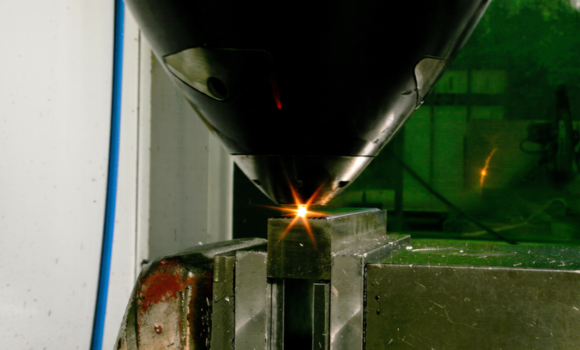
CFPR developed its approach around a Meltio Engine integration kit fitted to a HAAS five-axis CNC machine, combining Meltio’s wire-Laser Metal Deposition (LMD) with in-process CNC machining in a single setup.
Rather than enclosing the part in a powder bed, the LMD process deposited platinum wire into a laser-generated melt pool while the build remained accessible. The team could pause deposition at the point specified by the design, place or adjust the seed manually with a level of positional control unavailable to casting or PBF in this application, and then resume deposition around it.
Once the seed had been positioned, deposition could continue around it, creating a structure intended to support subsequent crystal growth.
The same setup could then switch to subtractive machining without moving the part to a second station. Deposition and CNC finishing were carried out sequentially on the same machine, eliminating intermediate handling and re-fixturing and therefore reducing the opportunity for additional positional error after the seed had been placed.
Researcher Michael White developed the other part of the system: a material-recovery loop for the by-products generated during processing. A localised vacuum extraction system, controlled through the same G-code used for the CNC cycle, captured platinum lemel and other machining by-products for reprocessing as they were produced, rather than allowing the material to disperse as swarf. Given platinum’s value, this recovery loop was an important part of the approach’s material-efficiency strategy.
Meltio also stated that wire-laser deposition was suited to platinum on technical grounds. The metal’s high melting point, which presented challenges during casting, was less problematic in a mold-free deposition process. The company further stated that the sustained, localised heat delivered by the deposition process was compatible with the requirements of the crystal-growth approach once the seed was in place.
The hybrid approach enabled CFPR to position the seed within the structure without displacing or damaging it, which the research team reported it could not reliably achieve with previously investigated methods.
Because the vacuum extraction system captured machining by-products as they were generated, CFPR expected the approach to produce less scrap and require less reprocessing than a casting route, while providing full traceability over where the platinum in each part ended up.
For a material as valuable as platinum, the ability to account for it at every stage of the process was significant, independently of any specific cost figure.
From research to production
At the time of the project, the neo-gemstone process remained a research effort rather than a finished production line. CFPR described the work as being actively tested and refined, with no production-scale process or cost model in place.
The project demonstrated an approach for positioning a seed accurately inside a metal structure during the build. Developing and validating this capability as a repeatable production process was identified as the next phase.
However, the underlying capability – pausing an AM build to position an object accurately inside it, then finishing the part on the same machine – also suggested applications beyond jewellery.
Applications requiring a sensor, marker or dissimilar material to be embedded within a metal structure could face the same fundamental challenge that CFPR addresses in this project.