Fives AddUp’s BeAM DED machines now compatible with ADAXIS’ AdaOne software
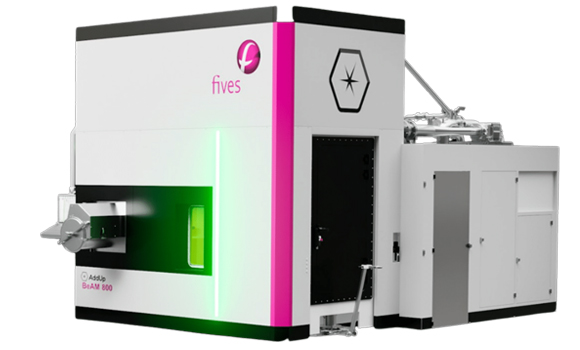
At Formnext 2026, Fives AddUp, headquartered in Cébazat, France, and ADAXIS, based in Bayonne, France, announced a strategic partnership in powder-fed laser Directed Energy Deposition (DED-LB) Additive Manufacturing.
As part of the collaboration, ADAXIS’s AdaOne software is now compatible with Fives AddUp’s BeAM 400 and BeAM 800 DED-LB machines. This enables users to prepare operations, generate complex multi-axis toolpaths, simulate machine movements and create programmes.

The partners will also work to improve communication between AdaOne and the BeAM machines, with the aim of facilitating access to machine and process parameters, improving programme transfer to the CNC controller, and enabling more accurate simulation of machine kinematics and toolpaths.
The partners also plan to incorporate the effects of physical phenomena specific to powder-fed DED-LB into the AdaOne environment, including variations in laser power and powder flow rates, process speed variations caused by machine acceleration and deceleration, and thermal accumulation during deposition.
The partners have identified four priorities for further development:
- creating toolpaths that account for the actual behaviour of the machine and process;
- thermal simulation applied to actual manufacturing conditions;
- using machine parameters and sensor data;
- programming functionally graded materials (FGMs) using AddUp’s BeAMix technology.
“This partnership with ADAXIS illustrates Fives AddUp’s commitment to providing an open and flexible software ecosystem for industrial Additive Manufacturing. By integrating our BeAM 400 and BeAM 800 DED machines into ADAXIS’ AdaOne software, we are giving our customers a new high-performance solution for programming, optimising and simulating their DED toolpaths. This collaboration also strengthens the capabilities of our Laser Technical Center, where AdaOne’s advanced toolpath generation and simulation features will support the development and validation of new laser applications,” said Thomas Elcrin, Process and Applications Manager, Fives AddUp.
Guénolé Bras, Chief Technology Officer, ADAXIS, added: “The challenge of DED is no longer simply to generate toolpaths, but to control what actually happens during deposition. By combining AddUp’s process knowledge with AdaOne’s digital capabilities, we aim to advance programming, simulation and the use of machine data. This practical collaboration between two French areas of expertise helps make DED technology more integrated and more accessible to manufacturers.”
Among the applications displayed by the two companies at Formnext is a large Maraging 300 steel valve additively manufactured using DED-LB on the BeAM 400, demonstrating a deposition rate of approximately 1 kg/h. The companies will also showcase the repair of a Ti-6Al-4V turbine blade using DED-LB on the BeAM 400, with toolpaths optimised using AdaOne software for multi-axis programming. Both applications will be displayed in Hall 11.0, Booth D32.