HP announces Metal Jet material developments and AI initiatives at Formnext 2026
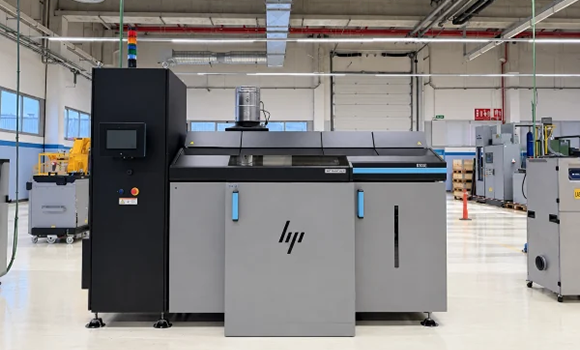
At Formnext 2026, HP Additive Manufacturing Solutions announced an expansion of the production capabilities of its Metal Jet technology, courtesy of new material developments and collaborations spanning nickel superalloys, pure copper and tungsten carbide.
These developments are intended for applications across aerospace, energy and thermal management. The relevant metal Additive Manufacturing collaborations include:
- Alloyed – HP and Alloyed, based in Yarnton, UK, have advanced the production of CM247LC nickel superalloy using Metal Jet Technology to achieve densities exceeding 98% of theoretical. The partners have also demonstrated complex component production, including turbine-wheel benchmarking, for high-temperature applications.
- IndoMIM – HP and IndoMIM, headquartered in Karnataka, India, have qualified IN718 nickel superalloy for Metal Jet technology, supported by a technical data sheet demonstrating mechanical properties of approximately 1,369 MPa ultimate tensile strength, 1,145 MPa yield strength and 20% elongation after heat treatment.
- Dauch – Pure copper Additive Manufacturing is commercially available from Dauch’s Auburn Hills, Michigan facility, expanding access to production-ready components for thermal management and electrification.
- Hyperion – Following the installation of an HP Metal Jet S100 machine in Barcelona in October 2026, HP and Hyperion, based in Worthington, Ohio, USA, are advancing the commercial production of tungsten carbide components. In October, the two companies announced a Strategic Preferred Partner Agreement aimed at expanding the commercial use of tungsten carbide (WC) Additive Manufacturing.

“This collaboration allows us to combine our decades of hard-materials experience with HP’s highly scalable Additive Manufacturing platform,” said Biju Varghese, Chief Technology Officer, Hyperion. “The result is a new manufacturing option for customers looking to create complex, high-performance tungsten carbide components and bring them to production with confidence.”
As announced at Formnext, HP is also exploring how AI could simplify Additive Manufacturing workflows and improve productivity. Areas of development include in-situ process monitoring using imaging and thermal data to help predict defects and recommend process improvements, as well as an intelligent service chatbot to accelerate technical support. The company is also exploring how printer telemetry and historical service data could inform maintenance needs and help reduce downtime.
HP is exhibiting at Formnext, Hall 12.1, Booth D41.