Siemens to demonstrate AI-driven Additive Manufacturing workflow at Formnext
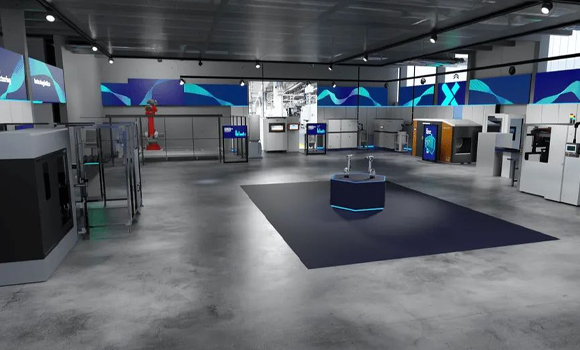
Siemens, headquartered in Munich, Germany, will showcase an Agentic AI workflow for developing task-specific, additively manufactured robotic grippers at Formnext 2026, taking place November 17–20 in Frankfurt. The demonstration is being carried out in collaboration with AGIBOT, based in Shanghai, China.
The workflow forms part of Siemens’ efforts to establish an end-to-end Digital Thread powered by Industrial AI for adaptive product development and production.
The user first describes the object to be handled and the desired task, while an Agentic AI workflow orchestrates the required engineering steps. It selects a suitable gripper type, adapts the geometry in Siemens’ Designcenter, simulates it, and then validates the robot interface and handling. Through MCP integration, the AI agent can access engineering software functions and prepare the data for Additive Manufacturing.

The intended result is a gripper tailored to the specific application, with a design that can be virtually validated and prepared for Additive Manufacturing before production begins.
“Industrial AI is fundamentally changing how we develop and manufacture products. Instead of manually designing variants in a time-consuming process, agentic workflows can orchestrate engineering tasks based on specific requirements. Additive Manufacturing is the ideal complement because it enables individual designs to be flexibly turned into physical components. The next step is production that can respond just as flexibly to this variety,” commented Karsten Heuser, Vice President Additive Manufacturing, Siemens.
The AM I Navigator, now enhanced with Industrial AI, is designed to help companies identify and prioritise potential applications in Additive Manufacturing, including design, engineering and production.
In collaboration with EOS and AM Solutions, Siemens is also developing an adaptive production cell at its Electronics Factory in Erlangen, Germany, intended to integrate Additive Manufacturing, automation, post-processing and software. The cell is intended to accommodate different components and production requirements while supporting repeatable, scalable production.
“The next stage in the evolution of Industry 4.0 is Industrial AI: the shift from connected and automated factories to intelligent, adaptive manufacturing. By combining Siemens’ expertise in industrial automation, software, and AI with EOS’ expertise in Additive Manufacturing, we aim to help shape this transformation. Together, we want to advance an independent European approach to the future of manufacturing and translate technological excellence into industrial competitiveness, resilience, and sovereignty,” said Marie Niehaus-Langer, CEO, EOS.
David Soldan, Head of AM Solutions – 3D Post Processing Technology, AM Solutions, added: “The industrialisation of Additive Manufacturing does not end with the printing process. Only when downstream processing steps are seamlessly integrated into the production chain can additive components be manufactured efficiently and reproduced at scale. With the adaptive production cell, we want to demonstrate together how Additive Manufacturing and automated post-processing can be combined into an integrated industrial process.”