Meltio launches US-assembled Robot Cell for metal AM
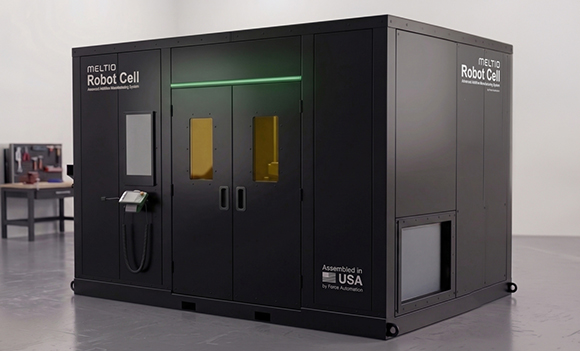
Meltio has introduced a US-assembled version of its Meltio Robot Cell, working with robotic integration specialist FORCE Automation Inc on the US initiative to manufacture and support the machine for customers in the Americas.
The Robot Cell combines Meltio’s wire-laser Directed Energy Deposition (DED) technology with an ABB industrial robot in an enclosed machine intended for metal Additive Manufacturing and repair applications.
According to Meltio, assembling the machine in the US is intended to reduce the shipping and customs requirements associated with importing complete cells from Spain, while allowing the machine to be configured for the US market.
The cell requires a single electrical power connection and an inert gas supply and is designed for operation in a controlled indoor industrial environment.
FORCE Automation has previously worked with Meltio on the integration of its deposition technology with ABB robotic systems in the US and was the company’s first official ABB Robotics integration partner in the country.
The machine is being targeted at applications including component manufacture, repair, feature addition, cladding and the production of spare parts. Meltio identifies automotive, aerospace, defence, mining, heavy industry, oil and gas, construction and shipbuilding among its target markets.
Case study
Meltio has also highlighted a number of existing applications of its robotic DED technology.
Swedish exhaust manufacturer Ferrita used a Meltio Robot Cell to produce four customised 316 stainless-steel tailpipes for a Mercedes-Benz SLR McLaren. The company combined 3D scanning and CAD modelling with wire-laser DED to manufacture the components without dedicated tooling. Meltio reports that the project reduced both production time and costs by approximately 50%.
In another application, Eurobearings integrated a Meltio Engine Robot Integration with a large industrial robot mounted on a mobile gantry for the manufacture and repair of large components. The company reports lead-time reductions of 30-50% for complex parts, as well as lower material consumption through near-net-shape production.
Meltio’s robotic DED technology can also deposit material directly onto existing components, allowing worn parts to be rebuilt rather than replaced.
Italian forging company Cavaletto Mario has meanwhile adopted the Meltio Robot Cell for the repair of trimming dies and punches previously repaired using manual electrode welding.
Cavaletto states that transferring the process to robotic DED has improved repeatability and eliminated the need to remove welding slag between deposited layers. The company reports cost savings of approximately 67% compared with traditional electrode welding and savings of around 20% in welding and subsequently machined material compared with its conventional mold manufacturing process.
Beyond repair, the Robot Cell can be used to deposit new features or material onto pre-machined components and forged substrates, as well as for hardfacing and cladding applications. Meltio also positions the machine for the on-demand production of replacement parts where conventional supply chains or inventories result in long lead times.