ASTM publishes guide for Defense AM certification
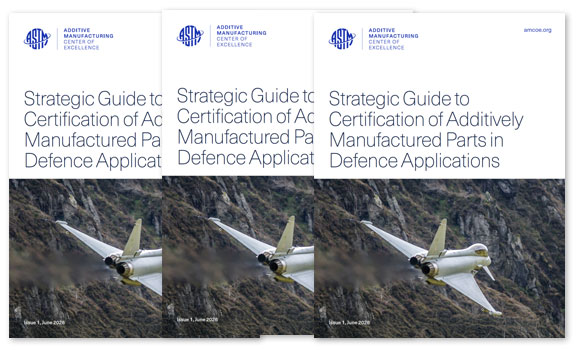
ASTM International’s Additive Manufacturing Center of Excellence (AM CoE) has published Strategic Guide to Certification of Additively Manufactured Parts in Defence Applications, intended to support the qualification and certification of additively manufactured parts for defence applications.

Developed to support the UK Ministry of Defence (MOD) and its Project TAMPA initiative, the guide provides defence organisations, manufacturers and suppliers with a common, criticality-based framework for qualifying Additive Manufacturing parts and supporting their certification across air, land and maritime applications. It is also intended to support defence supply chains and allied partners internationally.
According to ASTM International, certification requirements for Additive Manufacturing parts have varied between design authorities and prime contractors, creating a barrier to wider adoption across defence supply chains. Rather than introducing new requirements, the guide gathers existing expectations together in a single, technology-agnostic reference that links the level of certification evidence required to the consequences of a part failing in service.
The guide is intended as a signposting resource rather than a standard or regulation. It includes:
- A four-tier part classification system (Classes A–D) linking certification evidence to a part’s safety criticality
- Two certification pathways: one based on process qualification and the other on testing, allowing suppliers to adopt an approach proportionate to part criticality
- Guidance on certification evidence across core activities, including feedstock control, machine and process qualification, product verification and non-destructive evaluation
- Recommendations applicable across air, land and maritime applications, as well as across Additive Manufacturing processes and material families
- Guidance to encourage earlier engagement between manufacturers, design organisations and certification authorities, with the aim of reducing uncertainty and streamlining qualification
“Additive Manufacturing earns a place in defence only when a part can be trusted in service, and that trust depends on qualification and certification that hold up consistently across organisations, domains, and borders,” stated Mohsen Seifi, PhD, ASTM International’s Vice President of Global Advanced Manufacturing. “This guide gives manufacturers and authorities across the global defence community a shared, criticality-based reference point.”

Project TAMPA, the MOD’s Additive Manufacturing accelerator programme, identified inconsistent part certification as one of the principal barriers to scaling Additive Manufacturing across defence. ASTM International states that the project’s findings have helped inform the UK’s Defence Advanced Manufacturing Strategy and its vision for a network of certified Additive Manufacturing production capabilities shared with allies, including through US, AUKUS and NATO initiatives.
Although funded by the UK MOD, the guide has been written to be nation- and technology-agnostic, allowing defence manufacturers and allied supply chains beyond the UK to adopt the same approach. ASTM International emphasises that the publication represents pre-standardisation work and that any future formal standardisation would proceed independently through ASTM’s open, consensus-based standards development process.
The guide is available here.
ASTM International is inviting organisations applying the guide to submit feedback to [email protected], which will be considered in future revisions.