Gekonn addresses process repeatability in metal Additive Manufacturing
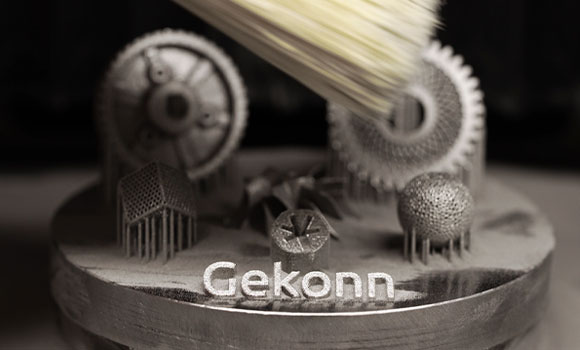
Gekonn, the metal Additive Manufacturing machine brand developed by Sipra, based in Maribor, Slovenia, aims to address a challenge familiar to many manufacturers transitioning from successful prototype production to stable, repeatable industrial manufacturing.
Rather than focusing solely on machine specifications, Gekonn emphasises process control, powder handling and engineering support, together with integration into industrial production environments, as key factors in achieving reliable metal AM production.
The company’s portfolio currently consists of three Laser Beam Powder Bed Fusion (PBF-LB) machines. The LMP 100v3 is aimed at research and development, tooling and low-volume production, while the LMP 200 targets small-batch industrial manufacturing. The LMP 300 is designed for serial production and larger industrial components, providing users with a route from application development to higher-volume manufacturing.
While producing an individual component is often achievable, maintaining consistent quality across multiple builds requires control of factors such as porosity, residual stress, oxidation, thermal gradients and microstructural development.
To address these challenges, Gekonn’s AM machines incorporate controlled processing environments, closed-loop powder handling and process monitoring capabilities intended to support both quality assurance and operator safety, particularly when processing reactive materials such as titanium and aluminium alloys.
The company also highlights the importance of open machine architecture. During material qualification and application development, engineers frequently need access to process parameters such as laser power, scanning speed, hatch spacing, layer thickness and scan strategies in order to optimise density, surface quality and mechanical properties.
Scan strategy management is a particular focus, as laser path selection can influence heat distribution, grain growth and residual stress development within components. Similarly, process optimisation can reduce the need for support structures, helping manufacturers minimise material consumption and post-processing requirements.
As manufacturers increasingly seek to move metal AM beyond prototyping and into serial production, Gekonn is positioning its technology as part of a broader engineering approach that combines machine hardware with installation, training, maintenance, process qualification and technical support.
For industrial users, the company argues that long-term success in metal AM depends not only on the laser system itself, but also on the control and understanding of the manufacturing process surrounding the part.