SPEE3D co-founder authors ASPI report on Australian industrial sovereignty
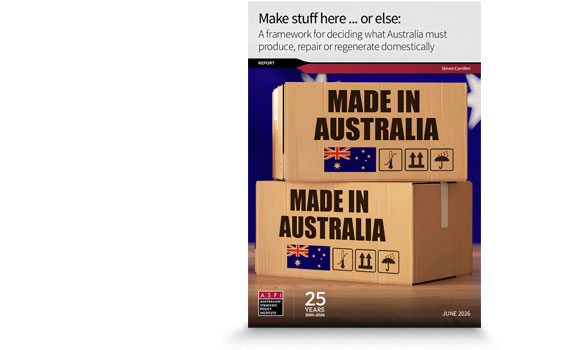
Steven Camilleri, co-founder and Chief Technology Officer of SPEE3D, Australia, has authored a report published by the Australian Strategic Policy Institute (ASPI) that proposes a framework for identifying the goods and capabilities Australia should be able to produce, repair or regenerate domestically.

‘Make stuff here … or else: A framework for deciding what Australia must produce, repair or regenerate domestically’ argues that national resilience should be treated as a measurable engineering challenge rather than an abstract policy objective. It builds on Camilleri’s 2025 Make Stuff Here blueprint.
Central to the report is the concept of the ‘sovereignty countdown’, defined as the length of time a critical system can continue operating if external supply is disrupted, relying solely on existing reserves, substitutes and domestic capabilities. According to the report, all essential systems — including water, fuel, food logistics, power and communications — have a sovereignty countdown, although many operators have not measured it.
To illustrate the concept, the report cites examples of publicly visible supply-chain dependencies which can be measured, managed and extended. These include:
- Water-treatment chemicals that may be held in sufficient quantities for only a few weeks
- Diesel reserves, wherein stockpiles are stored in weeks rather than months
- Imported fertilisers whose disruption may not affect crop yields until the subsequent harvest
Camilleri states that Australia faces a widening gap between policy ambitions and industrial capability. While resilience and sovereign capability have become priorities in government policy, rebuilding manufacturing capacity is a longer-term undertaking.

“Australia’s essential systems all run on a clock most of their operators have never started,” he explained. “The sovereignty countdown simply asks how long each system could keep going if supply stopped tomorrow. Once you can measure that, resilience stops being a slogan and becomes an engineering problem you can actually solve.”
The report emphasises that it is not advocating self-sufficiency or broad protectionist measures. Instead, it recommends rebuilding a limited number of capabilities where the time required to restore supply exceeds existing national buffers, while maintaining international partnerships.
“This is not about recreating the smokestack economy or making everything here,” Camilleri stated. “It is about identifying the capabilities we cannot afford to lose and rebuilding them on better terms. It is also about using distributed, digital and advanced manufacturing methods suited to a large continent with a limited industrial workforce.”
Among its recommendations, the report calls for a national resilience test for critical infrastructure operators, the establishment of minimum national survival thresholds for essential systems, and financing mechanisms designed to support resilience-related investments. These include a continuity investment window and the mobilisation of superannuation capital to support resilience initiatives without relying on permanent subsidies.
The full report is available here.