UNF receives NSF funding for metal AM quality control
Researchers at the University of North Florida (UNF), Jacksonville, Florida, USA, have received funding from the National Science Foundation (NSF) to develop an automated quality-control system intended to improve reliability in metal Additive Manufacturing.
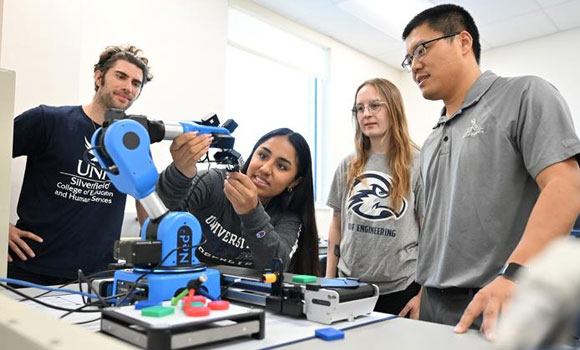
The project is led by Dr Longfei Zhou, Assistant Professor of Advanced Manufacturing Engineering, alongside a team of student researchers. The NSF award will support the development of a system designed to identify and correct defects during the metal AM build process.

The research focuses on Laser Beam Powder Bed Fusion (PBF-LB) technology, where defects can occur when the powder recoating mechanism disturbs the powder bed and creates streaks or irregularities that may lead to flaws in finished parts. The proposed system aims to monitor each layer during the build process and apply targeted corrections where needed, with the goal of reducing failed builds, material waste and energy consumption.

“The project aims to dramatically reduce those failures by giving 3D printers a fast, automated quality-control system that watches every layer and makes small, targeted corrections only where needed,” the university stated.
The researchers believe the technology could help improve manufacturing yields while supporting more sustainable production practices in metal Additive Manufacturing.
Student researchers participating in the project include advanced manufacturing engineering seniors Maria Fernanda Ocrospoma Figueroa, Tessa Baur and Taylor Uhruh. Baur serves as president of the Society for the Advancement of Material and Process Engineering (SAMPE) club at UNF, while Ocrospoma is vice president.
In addition to the technical research, the project plans to introduce new course modules and laboratory activities focused on the role of automation and data-driven technologies in manufacturing. The team also aims to release datasets, trained models, digital twin software and baseline decision policies publicly to encourage wider adoption and further research.