Canmora Tech debuts large-format LEAM-Q PBF-LB machine
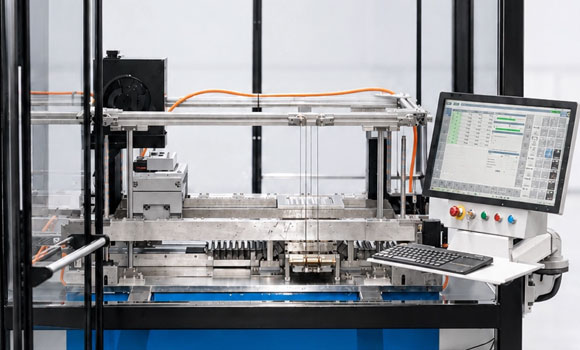
Canmora Tech Inc., Vancouver, Canada, introduced its LEAM-Q large-format Laser Beam Powder Bed Fusion (PBF-LB) Additive Manufacturing machine at the recent RAPID + TCT 2026, which took place in Boston, Massachusetts. The meter-class metal AM platform was developed to address build-size, productivity and process-control limitations in conventional PBF-LB systems.
“RAPID + TCT was the perfect place for us to present the LEAM-Q to the industry for the first time,” stated Ralf Edinger of Canmora Tech. “Our goal with this platform is to push beyond the traditional limitations of metal powder bed fusion by enabling larger builds, higher throughput and true industrial production capability. The response from visitors, partners and manufacturers exceeded our expectations.”
The LEAM-Q platform is aimed at manufacturers in aerospace, automotive, energy, transportation, defence, mining and heavy industry seeking to produce larger and more complex metal components. According to Canmora Tech, the system combines a scalable multi-laser architecture (with configurations of up to thirty-six independent lasers) with its patented 4Z tank technology and other proprietary developments intended to improve productivity, powder handling, thermal control and long-duration process reliability.
At the centre of the LEAM-Q is a configurable multi-laser system designed to increase production speed across large build areas while maintaining the precision and repeatability required for demanding industrial applications.
The machine features Canmora Tech’s patented 4Z tank technology, which has been developed to improve powder management, optimise thermal behaviour during the build process and enhance operational stability during long production runs. By addressing thermal consistency and process efficiency at scale, the 4Z architecture is intended to support more repeatable and reliable production of large metal parts.
Canmora Tech reported interest from visitors exploring applications including aerospace structural parts, propulsion components, automotive components, industrial tooling, energy systems, defence applications, transportation equipment and heavy industrial machinery.
“Industrial customers are increasingly asking for systems that can produce bigger parts faster and more reliably,” Edinger added. “During the show, we were asked about build volumes of up to 3 x 3 x 3 m. The LEAM-Q was designed with these challenges in mind. We believe the future of Additive Manufacturing depends on combining scale, productivity and process control in a way that truly supports industrial production environments.”