AFRL-supported research validates PanX for metal AM simulation
PanOptimization, based in State College, Pennsylvania, USA, has published research, supported by the US Air Force Research Laboratory (AFRL), in The International Journal of Advanced Manufacturing Technology, validating the use of its PanX thermomechanical simulation software to model entire build volumes in metal Additive Manufacturing.
‘Part scale prediction of residual stress through thermomechanical modelling of additively manufactured Ti-6Al-4V’ evaluated PanX’s ability to predict thermal and mechanical behaviour of Laser Beam Powder Bed Fusion (PBF-LB) Ti-6Al-4V builds.
According to PanOptimization, the research demonstrates PanX’s ability to address one of the key challenges facing industrial metal AM: reducing reliance on trial-and-error build development through the use of validated physics-based simulation models that support qualification, certification and production reliability.

“There is growing recognition across industry, government, and regulatory bodies that AM cannot reach full industrial maturity without physics-based models that can be trusted,” stated Erik Denlinger, co-founder and Chief Engineer at PanOptimization. “If simulation can predict the outcome of a build quickly and accurately, it becomes a way to identify and mitigate risk before material, machine time, and production schedules are put at risk. That is exactly where PanX is focused.”
The AFRL-supported study compared PanX thermal and mechanical simulation predictions with experimental measurements across complete build volumes containing multiple parts. This is significant because thermal and mechanical interactions between parts, surrounding powder and the build plate can influence build quality and must be considered when predicting build outcomes.
According to the published results, PanX predicted interlayer temperatures with errors ranging from 2–14% and identified crack-prone regions using a P-integral approach. The study also demonstrated that the software can accommodate varying geometries and build layouts, supporting its application across different component designs and processing conditions.
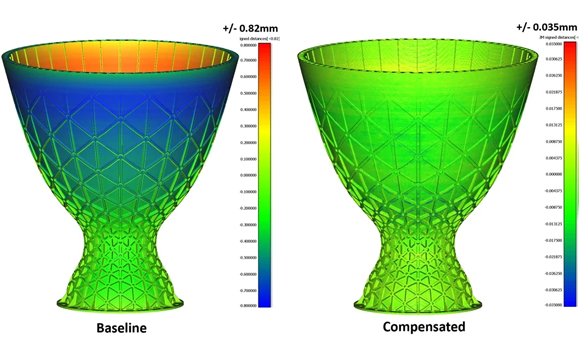
“The accuracy of simulation needs to be validated for it to be applied and trusted,” Denlinger continued. “The in-situ interlayer temperature measurements for full build volumes used in this study are the gold standard for thermal validation. The work should be extended to include actual energy input and machine timing, which PanX can already integrate with, and which our internal validation efforts have shown to be critical to further improving accuracy. PanX’s ability to accurately compute these temperatures is a competitive advantage for us, enabling optimisation of process timing, distortion compensation for tight tolerances, and many other applications.”
PanX uses a multi-grid modelling approach, combining a series of transient solutions to simulate thermal and mechanical behaviour throughout a build. The company noted that the published study did not incorporate actual machine timing or energy input, despite PanX being capable of modelling both. As a result, it believes the reported thermal prediction errors represent a conservative assessment of the software’s capabilities.
For manufacturers operating in aerospace, defence, energy, space and other high-value metal Additive Manufacturing sectors, the ability to predict build outcomes before production can reduce the cost of failed builds and qualification programmes. The researchers believe PanX offers manufacturers a means of assessing build risk before committing production resources.
As metal AM continues its transition towards serial production, the company believes accurate simulation of complete build volumes will become increasingly important for achieving consistent, repeatable manufacturing.