AP&C offering new coarse Ti64 powder for PBF-LB Additive Manufacturing
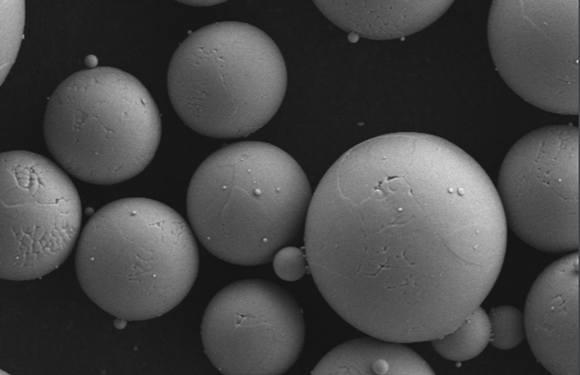
AP&C, a Colibrium Additive company, based in Québec, Canada, is now offering a coarse titanium Ti-6Al-4V (Ti64) powder suitable for Laser Beam Powder Bed Fusion (PBF-LB) Additive Manufacturing machines. The new coarse grade is reported to offer the same quality as AP&C’s finer powders, but with larger-size particles.
AP&C and Colibrium Additive – a GE Aerospace company – explains that Ti64 is a key material for Additive Manufacturing, especially in the orthopaedic industry, alongside cobalt chrome. There are also many Ti64 applications in the aerospace sector and is also used consumer goods products like bicycle parts, so it is relatively easy to find new niche applications for it.
Ti64 has already been widely adopted by the additive community compared to other alloys, which has led to optimised parameters for this material, making it easier to find business use cases.
What is coarse Ti64?
When metal Additive Manufacturing was first developed the data was lacking to identify the ‘ideal’ powder, and the volume was low, continues AP&C. So, the industry started with leftover powder from other conventional manufacturing technologies, such as Metal Injection Molding.
There was a need for fine powder, but because the layer thickness and laser power were low, it was soon identified that 0-15 µm was creating issues. Thus, the emergent PBF-LB technologies selected the 15-45 µm and 15-53 µm particle size distribution (PSD).
PBF-LB technology is now the largest market for spherical Ti64 powders, but by using only the finer fraction of the ‘as-produced’ PSD, coarser Ti64 powder becomes available and in need of a market. However, there is no technical reason why coarser Ti64 powder could not be used in the PBF-LB process with slight fine-tuning on deposition parameters. Larger Ti64 particles exhibit the same quality as the currently used 15-45 µm and 15-53 µm powders as they have been created using the same validated process.
In fact, similar coarse PSD are used in Electron Beam Powder Bed Fusion (PBF-EB) and Direct Energy Deposition (DED) with great results, but the penetration of those technologies remains small compared to PBF-LB.
Academic research, and AP&C’s own internal data, has shown that using larger particles with a tuned deposition process produces high-quality printed parts with comparable mechanical properties and excellent process stability. After extensive work and validations, AP&C is also commercialising a parameter for the Colibrium Additive M2 platform for coarse Ti64.
Coarse Ti64 powder is safer
Another important advantage to highlight for coarse Ti64 is that it is also safer than finer powder Ti64, since the higher PSD is substantially less reactive, the company is keen to highlight. Powder handling, storage and reuse could be significantly simplified and local regulations of powder storage are easier to meet.
Particularly, coarse Ti64 powder is not classified as flammable solid (while fine Ti64 is) and, more importantly, its minimum ignition energy (MIE) is high enough that the powder is not sensitive to electrostatic discharge which can change the applicable safety controls associated with using this powder.
By increasing the safety of the powder and reducing its reactivity, you can store more powder, and the storage is less disrupted in the facilities of the end user, it was added.
AP&C are at RAPID + TCT 2024, visit booth #1539