Researchers demonstrate crack-free metal–ceramic AM joints
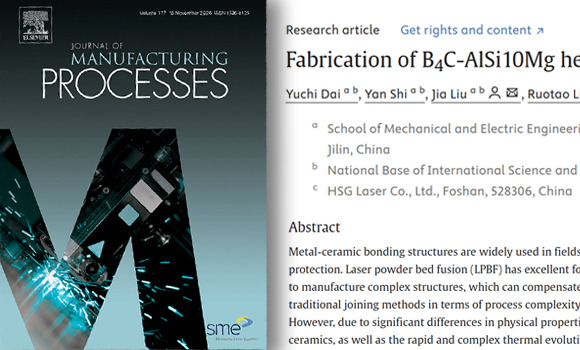
Chinese researchers from Changchun University of Science and Technology, the National Base of International Science and Technology Cooperation in Optics, and HSG Laser Co have demonstrated a method of joining boron carbide (B₄C) ceramic to AlSi10Mg aluminium alloy using Laser Beam Powder Bed Fusion (PBF-LB), overcoming challenges associated with residual stresses and cracking at the interface between the two materials. The research, published in the Journal of Manufacturing Processes, highlights the potential of Additive Manufacturing to produce complex metal–ceramic structures.
Metal–ceramic joints are used in a range of applications, including electronics, energy and protective systems, where the different properties of the two materials can provide functional advantages. However, conventional joining methods, such as brazing and diffusion bonding, can involve complex processing requirements.
PBF-LB offers an alternative approach, but differences in the physical and thermal properties of metals and ceramics can lead to substantial residual stresses during processing. These stresses, combined with the rapid heating and cooling associated with PBF-LB, can cause cracking and failure at the bonding interface.
To address this challenge, the researchers investigated the effects of laser scanning strategies and powder layer thickness on residual stress formation. By optimising the scanning strategy and introducing a gradient in laser energy input through variations in powder layer thickness, they achieved crack-free joining between B₄C and AlSi10Mg.
The team also examined the chemical reactions occurring at the interface during processing. Their analysis identified an in-situ dissolution–reaction mechanism, resulting in a B₄C/α-AlB₁₂/Al₃BC + Al₄C₃/Al composite interfacial structure.
The researchers used phase diagrams and heterogeneous nucleation theory to investigate how these interfacial reaction products formed and contributed to the development of the bonding interface.
Compression shear testing of the resulting joints demonstrated an average apparent interfacial shear strength of 17.76 MPa.
The findings suggest that controlling laser scanning strategies and energy input could provide a route to producing crack-free metal–ceramic joints using PBF-LB, potentially expanding the use of Additive Manufacturing for components combining dissimilar materials.
Fabrication of B₄C-AlSi10Mg heterogeneous joint structure via L-PBF process is available here.